



11 November 2026
Thank you all for coming to this very important lecture – important not just for me, but because of its tradition for KTF and the man we honour today. It is special that we're here on Remembrance Day, of course, and our poppies represent that. And I've already seen many of you this morning at the Australian War Memorial for the beautiful commemoration.
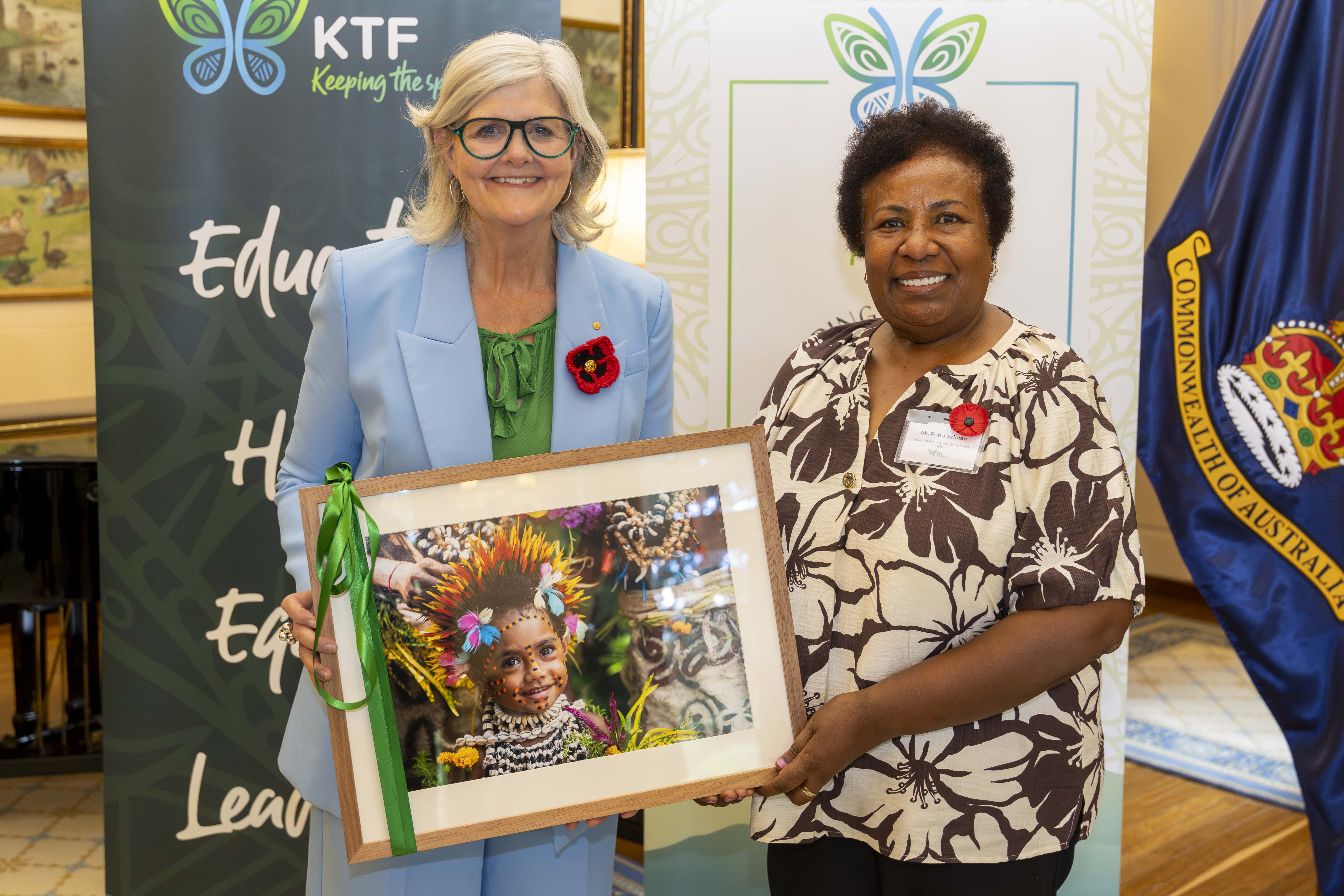
I want to let you know that the poppy I'm wearing was handmade by one of our team here at Government House. She's going to be very embarrassed. Sarah has been here for over 21 years, and she regularly creates poppies that go right round the country as part of a volunteer community. This one actually has the button of a former monarch – it's the E2R little button. I receive knitted and crocheted items from many people around the country, but I'm so delighted to receive this from Sarah. I wanted to thank her and wear her beautiful poppy today.
I want to also start by acknowledging that we are here on the lands of the Ngunnawal and Ngambri people, and paying my respects to their Elders, past and present. I also acknowledge the extraordinary amount of work that First Nations people have done for this country, for this land that we are on, for this place, but also as members of the Australian Defence Force over many years.
I also want to acknowledge all the former and current members of the Defence Force who are here today, including your families and those that have supported you. There are a few people I will also acknowledge. Gen has done a very good job, but you would understand as your Governor-General there are a few people I would personally like to welcome.
I'd like to start with Mr Joe Warisan, Acting High Commissioner for Papua New Guinea. I know your wife couldn't make it because of other duties, but it's wonderful to have you here at Government House. Then I have Their Excellencies representing Japan, Germany, and Canada. So, it's wonderful to have you back, Ambassador Suzuki, Ambassador Grzeski, and High Commissioner Wayne Robson. I saw each of you this morning, laying wreaths at the War Memorial. It's lovely that you could spend the afternoon with us, and we always love having the diplomatic community here with us.
Of course, another regular visitor and friend of ours, who we always enjoy having in the house, is Air Chief Marshal Sir Angus Houston AK, AFC, former Chief of the Defence Force, but so much more. Patron of so many organisations, mentor for so many, including me. It's wonderful to have you back here.
It's wonderful to have Ewen McDonald AM, Australia's Special Envoy for the Pacific, and a dear friend over many years. Wonderful to see you, Ewen; Elizabeth Peak, Deputy Secretary of the Department of Foreign Affairs and Trade; Ian Kemish AM, Chair of the Kokoda Track Foundation; and of course, Dr Genevieve Nelson, Co-founder and Chief Executive Officer; all of your Board members here today, your staff, your partners, and supporters.
I do know that the Honner family is represented by Caroline Honner. Caroline, we had a quick chat earlier. Your first time into Government House – you're so very, very welcome. There are many of you who are representatives of the Australian Government, Defence, and particularly the Papua New Guinean community. I just know there's a number of ambassadors here for Gender Equality – if I start to name you all, I will leave somebody out. So rather than do that as Gen has done, I acknowledge that this is a room of very distinguished guests, and you are all welcome.
I do want to acknowledge the Honourable Penelope Wensley AC, former Governor of Queensland. It's only Governors and Governors-General who understand these roles. It is a unique role, and we can only really share those experiences with each other and know what we're talking about. It is wonderful to have a former Governor here, and to acknowledge all of the other work that you have done, particularly as a Board Member of the Lowy Institute.
And I know Sarah Thompson is here, who directs the Australia-PNG Network. Such important work that Lowy does, and such a remarkable organisation. Chris Moraitis is here from the Office of the Special Investigator; Mrs Anne-Sophie Hermann, the Founder and Vice Chair of Buk Bilong Pikinini; and there are other people I'm going to reference in my speech. So, I'll come to many of you in a moment.
But I do want to acknowledge someone I haven't seen for a very long time. Serena Sasingian is the Founder of The Voice. She founded that almost 20 years ago. It's an extraordinary organisation based out of Port Moresby. I had the privilege of meeting you there, Serena, then travelling to Buka with Dimity Fifer, when she was the CEO of Australian Volunteers International. We stayed with Sister Lorraine in Bougainville. It was a remarkable moment for me to travel as your guest and see the work of The Voice that continues today. So, I'm so glad that you are here with us.
But, of course, we are here for remembrance and for the lecture. At 11 o'clock this morning, Australians paused to remember. Together with many of you, I attended the Australian War Memorial to honour the Australians who have served our country, those who lost their lives, and the families who have always carried the consequences of war. On the Memorial's 85th anniversary, it was a rare privilege to lay the historic wreath of scarlet poppies first laid there in 1934 by Prince Henry, the Duke of Gloucester, in memory of Australians killed in the First World War. You'll see photos of that wreath. It was a distinct privilege to hold it together with the Director of the War Memorial, Matt Anderson PSM, and place it on the Tomb of the Unknown Soldier.
And last week on Kokoda Day, I attended a very special service at the Kokoda Track Memorial Walkway in Concord, in Sydney, celebrating its 30th anniversary year. If you have not been to that Walkway, I would recommend a visit and several hours to do it. It's a remarkable gift to our country, which says so much about the relationship with Kokoda.
Veterans and families were there alongside the people who cared for the Walkway for three decades, preserving the history of the campaign for new generations. I was joined there by the acting Prime Minister Richard Marles, who gave a remarkable speech, Jennifer Collins AM, the Chair of the Kokoda Track Memorial Walkway, and Archbishop Rochus Josef Tatamai of Rabaul, to unveil a new granite plinth outside the Ralph Honner Kokoda Education Centre, incorporating soil from the Kokoda Plateau brought to Australia just last year. The inscription recalls the raising of the Australian flag at Kokoda on 3 November 1942, and honours the courage, endurance, mateship, and sacrifice of those who fought along the track.
Afterwards, I was very proud to lay a wreath alongside Jennifer and the acting Prime Minister. For 30 years that Walkway has recognised the courage of Australians and Papua New Guineans, including the Papuan soldiers and guides whose knowledge of the land was indispensable. The fighting also brought terrible sufferings to communities along the track, not just to Australian soldiers. We should always remember that.
At the service, Archbishop Tatamai spoke movingly of the Papuan carriers and stretcher-bearers who helped the wounded Australian soldiers, often at great personal risk. He reminded us of one of Kokoda’s enduring lessons: that courage means service to others.
Carole-Anne Priest, who's the Deputy Chair of the Walkway, remembered the veterans that she'd come to know over the many years and her sadness that she felt looking out into the audience for the first time with no existing veterans – the last of them having passed just earlier this year. She said that as they had joined her to teach about Kokoda on the Walkway, they had always taught her that “true strength is not always loud.” She said it was always about grace that cloaks care and stands up against menace. It was a beautiful, beautiful speech.
And today, with those words, I believe it's fitting that we honour the leadership of Lieutenant Colonel Ralph Honner.
Now, Gen didn't mention it, but I am a former orator of this lecture. In 2016, 10 years ago, I was very, very proud to deliver this oration. I could never have anticipated that a decade later I'd be doing so here, in this place, in this Office. But I am honoured to return to the role, particularly on Remembrance Day, and here at this very special place, Government House.
Ralph Honner’s life remains a powerful example of the responsibilities that leadership carries. As you know, in August 1942, he took command of the 39th Battalion at Isurava. He found young men exhausted by weeks of fighting, illness, and hunger; many having reached the limits of their physical strength. They faced further danger, knowing that much would depend upon the decisions of their commanders.
One of the men who observed Honner during the campaign was Stan Bisset, himself a distinguished soldier and Australian rugby international. In his book Kokoda Wallaby, Andrew James records Bisset's assessment of Honner as quiet and unassuming, a commander of great personal courage who had a deep understanding of and a genuine affection for his men. Bisset remembered Honner’s calmness under pressure. At Gona, the care with which Honner examined the ground before an assault showed the judgment required of a commander sending men into danger. After the war, he worked for many years, as you know, hearing veterans' pension appeals, and he remained very close to former members of the battalion and their families.
Honner made decisions in circumstances of mortal danger. His concern for the men under his command and for their families long after the war, gives his leadership enduring meaning.
Now there is a new and serendipitous connection to Ralph Honner in the family of Jamie Isbister, Australia's new High Commissioner to Papua New Guinea. I've known Jamie for a number of years through our involvement with the Australian Council for International Development and Australian Volunteers International, and he has often been in this House since I took up the role.
We caught up in a very particular way just before he left to take up his new role in Port Moresby. He shared with me that his father, Professor James Isbister, had cared for Ralph Honner when Ralph was unwell in the late 1980s. Today, we are deeply honoured to have Professor Isbister join us here, together with Jamie's wife Ruth and their son Liam. Very special to have you here, to join your colleagues and friends, and to have someone with such a direct connection to Ralph Honner.
The family's connections through Professor Isbister with Papua New Guinea, go back to the Second World War, when James's father, and therefore Jamie's maternal grandfather both served there. One as a doctor, and the other as an ambulance driver. In the early 1970s, James worked as a doctor at Port Moresby General Hospital. His sons – Jamie's earlier memories are of a city in 1973 and ‘74 in the years leading up to independence, and of course it was last year that that beautiful country marked the 50th anniversary of its independence. It was an occasion to recognise the generation that led that country to nationhood and the achievements of Papua New Guineans over the five decades since.
Of course, at the ceremony to lower the Australian flag on the 15th of September 1975, was one of my predecessors, Sir John Kerr. He was there to receive it, and Papua New Guinea's first Governor General, Sir John Guise, spoke words that have endured. He said, "We are lowering the flag, not tearing it down."
Among those who brought independence about was Papua New Guinea's founding Prime Minister, Grand Chief Sir Michael Somare. To have Sir Michael's daughter, Dulciana Somare-Brash here with us today in the front row next to Sir Angus is very, very special. I'm so, so pleased that you are here to share these moments with us. At your father's funeral, you spoke movingly of his vision for Papua New Guinea, recalling how he had dreamed Papua New Guinea into existence. It's a beautiful tribute to your father and the hopes he held always for your country.
Of course, more than 50 years on, our countries continue to work together across security, economic development, education, and health. The Pukpuk Treaty is an important development in our defence cooperation. But our friendship, as you all know in this room, has always reached beyond governments through the relationships built with one another – it's always about the people. Papua New Guineans contribute to Australian communities in so many ways through the PALM Scheme, while students, researchers, and teachers work across our universities and many of our educational institutions. There are many long-standing ties between churches, volunteers, families, and community organisations built over many decades.
Now, in 2013, I visited Papua New Guinea. As you know, that's where I met Serena through my involvement with both ACFID and Australian Volunteers International, but also as a Commissioner then with the Australian Football League – the only game of footy. In Port Moresby and Bougainville, I met women leaders from the parliament and universities, including one of Bougainville's early women parliamentarians and women from religious communities who had helped sustain people through very difficult times.
So, I met those women and learned so much more about the generosity of so many people across Papua New Guinea during that time, and I remember deeply the strength of their commitment to the people around them and who they were protecting.
Now I've mentioned my brand of footy, but of course there is sport between us. It was moving for me back in 2013 to present medals to the local Australian rules football teams in Port Moresby after the national competition. That's when our game was still popular in Port Moresby. There were lots of games, it was a hot weekend, and I presented many, many medals to both the men's and women's teams. I return to the photographs from that occasion all the time because it was such a joyful moment. After the formal presentation, I was simply pulled into an enormous group hug with hundreds and hundreds of women and men who love the same game as me.
So, you know, I'm very much an AFL person, although I do have a soft spot for all of the football codes and all sports. And I sort of then hadn't given up hope for AFL in Papua New Guinea, but nowadays I think I just have to resign gracefully and say rugby league has won that contest.
And I've seen that enthusiasm when I joined Papua New Guinea leaders, parliamentary leaders, and many others at a rugby league match in Sydney, which followed the announcement of the country's new NRL team. And what I remember about that is just how natural again the friendships felt. That team is going to be extraordinary. The PNG Chiefs are preparing for their first NRL season in 2028. Prime Minister James Marape has described them as ‘the team of the Pacific,’ reflecting the ambition to create opportunities for players and for people across the region.
The club is led by CEO Lorna McPherson, who has made a substantial contribution to rugby league in Papua New Guinea, including, very pleasingly, women's competitions. The unveiling of the club's logo and jersey in Port Moresby last month was another big milestone. And one of the players signed to join the Chiefs is Connor Watson, who walked the Kokoda Track with his Sydney Roosters teammates just late last year.
I hope you'll watch the International Rugby League competition as well. There were many matches played out of Port Moresby. Those games between Pacific nations were truly exciting and made me feel a little bit like I've missed something in rugby league over the years because it was truly outstanding sportsmanship and wonderful to watch, and it's not over yet.
In September, just this year, I was very, very privileged to welcome 10 church and faith leaders from Papua New Guinea to Admiralty House, where we spent an afternoon together. We spoke about the place of faith and volunteering in community life, and what brings us together. Of course, I offered the suggestion that the other religion was sport. I thought it might be a bit rude, but everyone had a laugh, so I think I was on it. But of course, whether it's the faith organisations, community organisations, or sport, it's volunteers and people who show up who have long helped build the people-to-people links between Australia and Papua New Guinea.
I'm going to mention a dear friend of mine, Kurt Fearnley. Kurt and I served together for many years on the Board of Australian Volunteers International and spent long periods of time together. He's a dear friend and someone I know all Australians deeply admire.
You'll know this, Kurt was born with a congenital disorder, which prevented the development of the lower part of his spine, so he has never had legs. He uses a wheelchair, but that has never stopped him from fully participating in every part of a very busy and dynamic life. Kurt's achievements as a Paralympic athlete would be well known to you. His role as a wheelchair racer is just extraordinary, and his contribution as a disability advocate and mentor match the medals. And he has a lot of them: 22 medals, including three gold Paralympic ones and the rest across world championships and many at the Commonwealth Games.
He is an astonishing athlete, but that advocacy for others is just as important to him. In November 2009, he undertook one of the most demanding challenges: crossing the Kokoda Track. But the crossing of the track was different for him. For 11 days, Kurt crawled his way across the 96 kilometres of steep mountains, rivers, mud, and jungle. It took enormous determination, incredible preparation, and the support of family, friends, and Papua New Guineans who travelled with him. Many wanted to help carry him. Many offered other ways of him crossing the track. He didn't take up any of them. He crawled the entirety of the track.
Among those helping him was Mac, a Papua New Guinean porter. He wasn't allowed to carry Kurt, only his pack. He helped with Kurt's wheelchair and repeatedly offered to carry him. And Kurt said, "When I buried every part of my strength into that day, he was always there.”
That's what kept him going.
Kurt also did something important on that day, which I think is a great act of leadership – he met Papua New Guinea families and children in each of the villages. He asked for those who had children with disability. He asked them to bring the children out of the huts, out of the dark, and out to be celebrated – something that was counterintuitive to the villagers in many cases. Those encounters have remained very important to him, but I suspect even more so for the villages along Kokoda. Some of those children had never been taken beyond their homes, and so it was Kurt who spoke about the care and protectiveness of families, the barriers that people face, and how much difference education, accessible environments, and wider opportunities could make for those young people. What a gift. What an extraordinary man. Just a natural leader in every respect.
He's carried that commitment through, and he's now the first person with disability to chair the Board of the National Disability Insurance Agency. It's Kurt’s determination to make room for others to participate and lead, that I think is one of the great attributes of leadership. I think it speaks to Ralph Honner as well.
Now, when the Prime Minister invited me to serve as your Governor-General, he asked me to be modern, visible, and optimistic. Before taking Office, I sought the advice of all my living predecessors and the Governors around the states and territories. I also listened to people in cities and regional communities, including Australians whose work seldom received public attention.
I wanted this Office, in meeting the Prime Minister's vision of modernity, visibility, and optimism, to also do something else – to reflect our modern country and to help Australians see the contributions of others. And for that reason, at my swearing-in before the Parliament in July 2024, I committed to putting care, kindness, and respect at the centre of everything I would do, together with all of the team here at Government House.
So, it's modernity, visibility, optimism, care, kindness, and respect. Those six words can be used interchangeably to help define what I think we should be doing here and the things we should be celebrating as part of leadership.
And as many of you would know, I grew up in an Army family, so as children, we knew a lot about service and reconnaissance. We were the kids that were up early for every Anzac Day dawn service, and my parents taught us – both my mum and my dad – the importance of serving others, always treating people with kindness and respect, and being able to debate ideas without anger or judgment of others. And now, in this role, I've seen the power of care, but also in the jobs I had before I came into this Office. They were always places that were inclusive, whether it was in business, in sport, or the charitable sector. I saw it in the advancement of women, the work of teachers, nurses, and carers. But not only in those areas: the best places I worked in cared deeply for everybody that they took care of or they served.
I see it now, of course, in this role when Australians respond to bushfires, to floods, and many other crises, often without being asked. And when I spoke of care at my swearing-in, I meant it in the broadest sense. I meant care for one another, care for those that do the caring of others, care for our continent and its environmental riches, and all of the extraordinary gifts that the continent has given us – another way of saying care for Country. Care for our civic institutions and care for how we discuss the difficult issues of our time, always with respect, never with division and hatred or anger.
And if you think about care in that way, more as a set of leadership attributes, you can't think of care as soft. Care has never been a soft option, although I think it's often described as soft or feminine. I think care is rigorous: it demands preparation, difficult decisions, and giving up a lot of ourselves. To be really caring is an accountable act. It's the willingness to stay engaged when the work gets harder and harder, even when the circumstances of the person giving care are also getting harder.
And so, one of the great privileges of serving in this role is to get the panoramic view of this country, and to see the total picture, not just of care, but how we're getting on as a nation. And then to drop often down deep into the fine grain of communities, and to see up close what it is that people do for each other across Australian communities. And I see everywhere a national project of connection and belonging in the care people give, the responsibilities they accept, and in many ways they contribute to this country. I wish that was a story we were telling ourselves at a national level, because the national story we talk about is social cohesion drifting or fraying. I know there are risks, but when you actually look at what's at the heart of this country and its relationship with Papua New Guinea and all of our neighbours, we are doing an amazingly good job of ensuring that we are a country that has a very bright future because we do care about each other.
Now, two days ago, I delivered the Betty and Shmuel Rosenkranz Oration in Melbourne, and that was also about reflecting on history, memory, and responsibility. And being at the Kokoda Day service last week, now gathering on Remembrance Day, the Rosenkranz lecture was all about what does memory ask of us? So, I think of these three moments of Kokoda, remembrance, and then Kristallnacht, which we marked just the other night, - the beginning of the problems and the beginning of the terrible, terrible antisemitism across Europe that led to so many people coming here after the Holocaust.
During the service at Kokoda, Archbishop Tatamai recalled an Australian soldier's words about the Papuan carriers who helped the wounded. I know 'Fuzzy Wuzzy Angels' was the term used at the time, and many still use that. But Archbishop Tatamai said that the carriers described the soldiers as their brothers – and meant it.
In Melbourne, when I was delivering the Rosenkranz address, I recalled one of my lovely predecessors, who's still around at 95, who lives just around the corner, Sir William Deane, and he drew on the Jewish tradition of caring for others. And at the opening of a Jewish community centre when he was Governor-General, he spoke of the belief, ‘I am my brother's keeper.’
We are each other's brothers and sisters. I think there's responsibility in all of those words to recognise when another person needs our help and to act, and that it's a profound act, not just of friendship, but of brotherhood and sisterhood. So, I've been asking myself a lot in preparation for today: What is the history we're creating now? What will future generations remember of how we responded, and did we really turn up with care, as Ralph Honner and those at Kokoda did?
And the reason I'm trying to join these things together is we're about to enter into the first anniversary of that despicable antisemitic attack at Bondi. And I've been speaking with Jewish Australians not just there but around the country about that moment, about that attack, and what it now means for our country. And hopefully, it is not the beginning of losing our social cohesion. But it is unimaginable that such an attack could take place on Australian soil, the worst terrorist attack on our soil ever.
And yet, many Jewish Australians for many years had been raising concerns about antisemitism and the lack of safety. Often, they had not been heard. We were not thinking about them as brothers and sisters; we had been neglecting something. And so, in my conversations not just with the Jewish community, but with all the communities that make up modern Australia, including our Papua New Guinean brothers and sisters and our nearest neighbour, I keep returning to these questions: who are we as Australians? What kind of country do we want to keep creating? And what responsibility do we share to ensure that people can live here in safety and dignity, and really believe that?
At Bondi, members of the public and first responders placed themselves in danger to help others, and their bravery reflects the words of former police officer and Cross of Valour recipient Allan Sparkes CV OAM, who often comes here to Government House. And he spoke here just recently and said, "For me, bravery is about caring.”
He speaks of bravery being all of us caring for others before they have to ask. This story of what is bravery, what is courage, coming back to the word care, in the voices of those who won bravery and valour awards, reminds me that bravery is actually all about care, as is leadership.
That courage, I think is what we now need for the sustained work of confronting hatred, listening to people who do feel unsafe, and making decisions to protect their dignity and belonging. And that's a responsibility I think must be matched by a responsibility to respond. Those responsibilities, as I say in my care formulation, actually extend to how we care for our democratic life.
Last month, I was in Euroa at a recovery hub after the bushfires there, and I was with my friend Helen Haines. We were meeting people involved in bushfire recovery. We were speaking about encouraging more Australians to participate in our democracy, and about how we might listen better to each other with respect, especially when we disagree. As always, Helen was listening with her entire body, as she has always done in her electorate of Indi, but she was thinking mostly about the community of the future and who we can be. So, the fact that only a few days later Helen was so viciously attacked has distressed everyone across the country.
It's been a terrible time for her and her husband Phil, but they asked me very generously to stand alongside Phil when he revealed the result of her injuries, a double amputation, and asked me to speak to Australians from the hospital about decency and civility. Of course, I know everyone in this room and all of Australia’s thoughts remain with Helen and Phil and their beautiful family, and all of those who are caring for her. And I'm glad to tell you that I saw her again on Sunday night at the Alfred Hospital and had just over an hour with her. And she is a life force.
The care she's always shown for others, and the care she's now feeling deeply through the good wishes of everyone in Australia and around the world, is giving her a great deal of optimism and hope. It's remarkable to be with someone who's experienced catastrophic injuries at the hands of someone who did it deliberately, but can still have life shining out of her, smiling and already thinking about how she'll help make our country better and better. So, she's doing well. She has a long recovery ahead of her, of course, but it was wonderful to be reminded that good people actually endure, and her medical support said they think she brought something into her injury far beyond anything they could have fixed through their medical procedures. It's her spirit, and that's why I'm caring deeply for everybody.
It’s been a wonderful chance to see her, and I've been really moved by the courage and care of everyone who raced to Helen's aid. It wasn't in a war environment, it wasn't down at Bondi, it wasn't at Kokoda. These were ordinary people: the local barber who jumped in to stem the bleeding and save her life, the emergency medical teams, and the thousands of Australians who have now reached out with kindness and concern. And of course, being Helen, she said, "Please don't buy flowers. Spend that money and give money to Save the Children fund." And that fund, at the moment, through those donations, is almost at $1.5 million going to the care of children around the world. That is so typical of Helen and Phil.
And so that attack and the response, I think, reminds us how we have got to protect the ability of people to participate in public life without intimidation or violence. In fact, we have to protect each other all the time and make sure that, in our democracy, despite having robust, passionate debate, we still have the freedom to question our leaders and hold us to account. We then need discipline to listen, to wrestle with ideas rather than people, and to remember that words have consequences. Whether spoken, or uttered, or written online, or offered anonymously or through a bot. We can all exercise our muscles of decency.
So, when I'm thinking about what gives me optimism, and I think about where we are all at and why we're here to talk about Ralph Honner, it's that for the reason that many of you are here, you only need to look at young people, both here and in Papua New Guinea, to actually reflect on what does new leadership look like and where it's coming from. And the young Australians I meet, 20,000 of them come through this House every year, they are extraordinary. Their questions and their curiosity about how our country works are one of the great pleasures of this Office.
Earlier this year, I welcomed students from the National Schools Constitutional Convention. They have spent days examining our constitutional arrangements, asking searching questions, and debating the principles of our democracy. They are extraordinary, and they're just getting started.
Over at the National Electoral Education Centre, I met students studying Charles Nuttall’s great painting of the opening of our first Federal Parliament in 1901. Again, full of questions and optimism, they want to understand our history, and they were reaching for copies of the Constitution, and being the great nerds that they are.
So, I have seen that here most recently this week: we had the Rhodes Scholars finalists here, the Duke of Edinburgh Gold Scholarship Awards, and the Order of Australia Scholarship Awardees. Those of us in public life, those of us that have a voice, I think owe all of them our leadership and how we show up as an example of respect. We need to let them know that their leadership matters as well, and that we will behave well. And so, it's important today that we look to the responsibilities being taken up by our closest neighbour, Papua New Guinea, where local leaders are using their knowledge and experience to create opportunities for others.
The Kokoda Track Foundation's work offers wonderful and inspiring examples, and we know that the Foundation was established on Anzac Day in 2003, inspired by the history of Kokoda and a commitment to supporting those communities along the track. Two decades later, it's been building enduring partnerships in education, health, equality, and leadership, working alongside and respectfully with Papua New Guineans who know their communities and know what is needed.
As Patron, I couldn't be more proud of that commitment.
Ian, Gen, all of your members, your Board, all your colleagues and your supporters, I want to thank you for the sustained care work that you bring to all that you do at KTF. I always want to recognise three Papua New Guineans doing important work in their communities. One of them is Jerome Sesega, and when I last delivered this oration, Jerome was a participant in KTF’S Archer Leadership Development Program. 10 years later, he has established an impressive career in law, banking, and educational governance.
Both of Jerome's parents taught at Port Moresby Grammar School, where he was a student, later becoming head student and dux. Today, he chairs the school. What an extraordinary circular story of great success! Jerome also serves on the governing council of Balimo College in Western Province, helping strengthen opportunities for the next generation of teachers and nurses.
There's also Patricia Diveni, whose connection with Kokoda College reaches back to its very beginnings. Patricia was present in 2012 when four Kokoda veterans turned the first sod for the college. Today, as Student Welfare Coordinator, she supports people who are making remarkable efforts to continue their education. Some walk for up to three days to attend classes, leaving their families and children behind. Patricia ensures that they have the guidance, care, and encouragement that they need, including the students with disability – Kurt Fearnley’s work at play.
Almost 1,500 people are now studying through the college's flexible learning program. And remarkably, something Australia could learn from – in 2026, women account for 48% of the students, and many of those women are balancing their studies with substantial family and community responsibilities. And Patricia’s support helps them along the way.
And lastly, I want to recognise Serah Teonda. In 2011, Gen, you met Serah at Buna Primary School, where she was a young grade six student with an ambition to become a nurse. KTF supported her schooling, and some years later she received the Carolyn Lister Memorial Scholarship to train as a community health worker. The scholarship commemorated Carolyn Lister, an Australian nurse and Army captain who travelled to Papua New Guinea with her husband John. After her death, John established it to help Papua New Guinea women train for careers in healthcare.
Serah completed her training in 2021 and has since worked in communities across Oro Province. Today, she serves at the remote Sinifara Aid Post, where she is the only woman community health worker. And in the first six months of this year, she has supervised 11 births, and the aid post has recorded almost 1,200 patient visits. Her work for a remote community means being able to get care closer to home. That is deep, deep care.
15 years after telling you, Gen, that she wanted to become a nurse, she is now caring for patients as a qualified community health worker, and now she wants to become a doctor. There's no doubt that will happen.
So those three have taken on different responsibilities. They are leaders, and they've been taken by leaders to make sure they can make an important contribution to the people around them. Their leadership, and all the relationships that KTF has sustained over so many years, inspires us all.
So, in conclusion, you'll be glad to know, many of you have walked through the Bravery Garden on your way into Government House from the car park today. It was established 25 years ago by Sir William Deane. Sir William was moved to create that place after visiting Gallipoli in 1999, reflecting on the courage of those who placed themselves in danger to help others and the lives lost through that service. He spoke of bravery as, "a tide that flows from the essence of our humanity."
It's a moving thought on Remembrance Day as we remember Ralph Honner and the men who served under him, the covenant women who shared the suffering and the danger, and the families who have carried the memory of those who did not return.
Remembrance asks something of us. It asks us to cherish the peace we've inherited, to care deeply for one another, and to stand by those whose safety and dignity are threatened, to sustain our democratic institutions and to strengthen friendship amongst our peoples. What we make possible for those who follow will be part of how we honour those who came before. That's the leadership that is completely embodied by Ralph Honner, whom we honour today in this oration.
We can all be brave. We can all show care, decency, and civility, even when we disagree. And we can now step up and be the examples that are being created by young Australians and Papua New Guineans, any of us who are in offices of influence.
So today, for Ralph Honner and Remembrance Day, I think we all just commit ourselves to the world of care.
Lest we forget.