



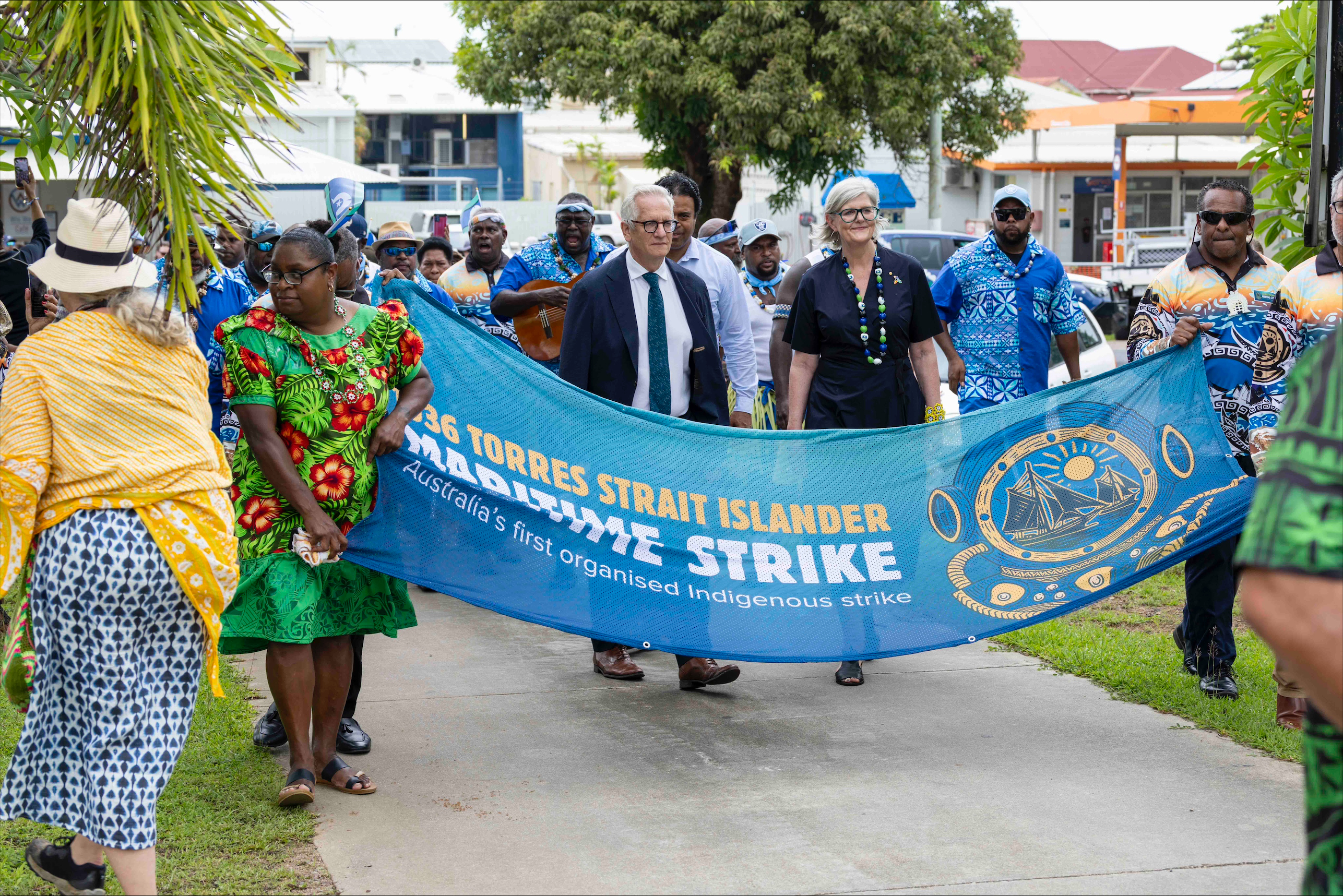
Speech delivered Wednesday 14 January, at Anglican Hall, Thursday Island
GOVERNOR-GENERAL:
I’d like to start with an acknowledgement.
I want to thank Enid for that remarkable and generous welcome, and for sharing a story that many of us – including me – did not know.
I also loved hearing about your work building resilience for the future, as your father and grandfather did, and your work with young people.
Enid welcomed me and our party at the airport yesterday; it was such a beautiful welcome.
I acknowledge your people—the Kaurareg people—and the Traditional Owners. I pay my deep respect to you, to your Elders past and present, and to the young leaders you are nurturing.
I recognise the enduring connection of the Kaurareg people to land, sea, culture and traditions, and their continuing role as custodians of this beautiful country. I extend that respect to all Torres Strait Islander peoples here today, and to Aboriginal and Torres Strait Islander peoples across Australia, honouring their cultures, resilience and extraordinary contributions to our nation.
Thank you to Kenny Bedford – what a wonderful MC.
Thank you also to Father Steven and Pastor Fred for leading us in prayer and song.
I want to speak about a few very special people.
Ned David, Chair of the GBK – hearing your words made mine seem insufficient.
You said, “Our culture is our archive.” I think we should all take that with us. Thank you for your leadership, your friendship, and for inviting Simeon and me to make this journey.
As you said, it has taken 90 years. It should have been celebrated earlier, but here we are – ten years from the centenary.
I’d also like to acknowledge Elsie Seriat, Mayor of Torres Shire Council. We last saw each other in Canberra at the ANU for the Zenadth Kes photographic exhibition, which we then saw again in Osaka. To see Torres Strait culture in Japan was very special.
Senator the Honourable Nita Green, Assistant Minister for Northern Australia, Tourism and Pacific Island Affairs, and Matt Smith – welcome.
To George Nona, Chair of the Torres Strait Regional Authority; Philemon Mosby, Mayor of the Torres Strait Island Regional Council; Nana Hill, CEO of IUIA; Joanne Schneider, Chair of Community Enterprise Queensland; and to Gail Mabo – who recently tried to teach me some moves! – wonderful to see you all.
To Thomas Mayo, whom I saw during the Voice campaign, especially speaking to multicultural communities in Sydney – remarkable work. Wonderful to see you here, Thomas.
Thank you to the schools, universities, museums, national organisations and all who have worked so hard to curate the exhibitions and seminars this week. It is educating all of us about what happened here 90 years ago.
This morning it was also an honour to attend a roundtable at the Torres Strait Regional Authority offices, where many leaders shared important reflections – including the expectation that this is not just a commemoration, but a call to action.
Simeon and I are deeply honoured to be invited to mark the 90th anniversary of the 1936 Torres Strait Maritime Strike – a moment of reflection, education and recognition leading up to the centenary in 2036.
We came for many reasons.
Ned made the approach from a ceremonial point of view, but it was also deeply personal.
So, I would like to ask Simeon, my husband – who has a long and deep connection to this place – to reflect on what this commemoration means to him.
SIMEON BECKETT:
Thank you, Sam. And thank you to the Traditional Owners for an empowering Welcome to Country.
Sam has already acknowledged many people, but I want to especially thank Ned, Elsie, George, Philemon, Matt and Beta, who are all here today.
The ties of Torres Strait run deep in my family. I am named Simeon because it was a common name here when I was born, and more particularly, my father was adopted by Asad Waruna when he lived and worked here. Over the past couple of days, many people have said how much I look like my father – and I hope that’s a good thing.
My father had a long association with, and love for, the Torres Strait for over 50 years. He lived for long periods on Mer, on Badu, on Saibai, and many other places. He forged strong personal relationships across the region. As an anthropologist, he recorded stories, he taped music and dance, he spoke Kulkalgau Ya and Meriam Mir, and he wrote extensively.
After he died, it was Torres Strait music and dance that farewelled him at his memorial.
The 1936 Maritime Strike features prominently in his book, written in the 1980s. The cover features a photograph of Marau – one of the main strike leaders from Mer – whom my father knew well. He dedicated the book to Marau and many others.
So, when Ned asked me to come and celebrate the 90th anniversary – and that the Governor-General could be here on behalf of all Australians – it moved me deeply.
Ned’s father, Uncle George Mye, was one of my father’s closest friends for over 50 years. My father would have loved to be here today – to see old friends, and their children and grandchildren – but he would also be delighted that the stories of the strike, finally, are being commemorated here.
For him, and for me, it was a deeply significant moment: when Torres Strait Islanders stood together against the oppressive laws of the 1930s.
So, to everyone here: Esso. Thank you.
GOVERNOR-GENERAL:
So now you know – this is very personal for us. I wish we could have brought our daughter, Lotte Beckett; carrying the Beckett name means a lot.
But I’ll return to my role as Governor-General.
We have heard so much about what happened 90 years ago. I want to offer a few reflections.
This year, 2026, marks the 125th year of Federation.
It was only 35 years into that Federation that the events here changed so much – not only in the Torres Strait, but across Australia. The 1936 strike profoundly changed the path toward rights and respect, and set in motion representative government in 1937.
We are sitting here outside an Anglican church – an important location, because Bishop Stephen Davies, supported by his wife Joan, spoke passionately at the 1935 Synod about the oppressive protection laws. His words helped spark what followed. It was extraordinary language for a nonIndigenous leader at that time.
As your Governor-General, I have a similar capacity to speak from a ceremonial and constitutional role – to shine a light where it is needed, and to reflect the nation back to itself.
Many of my predecessors have visited the Torres Strait – Sir Ninian Stephen in 1987, Major General Michael Jeffery in 2005, Dame Quentin Bryce in 2013, and General Sir Peter Cosgrove in 2018. It was time to return, and I’m honoured that the reason is this commemoration.
When I was sworn in 18 months ago, I committed to placing care, kindness and respect at the centre of all my work – and to travel to parts of Australia where essential stories needed to be shared. This is one of those stories.
This morning, we heard an extraordinary story from Lucy Guivarra, about her father – then just 18 – who held steady an outrigger canoe between Saibai and Masig to secretly deliver delegates to the strikers’ meeting. This is just one story of bravery among many.
This anniversary is not only a Torres Strait story. It is an Australian story. A national story.
The archival exhibition yesterday was wonderful. I hope those archives can be expanded and shared widely across the country. I’m pleased that IUIA also holds the collection of Jeremy Beckett’s recordings from the Torres Strait and Western NSW.
To me, the strike represents unity in pursuit of equity and self-determination.
And that same spirit is needed today – facing challenges such as climate change, rising seas, the protection of cultural sites and sacred stories, and the need for solutions grounded in cultural knowledge.
As Governor-General, I do not have politics, policies, or money. My role is influence – bringing compassion, shining a light on stories, and interpreting the nation to itself.