



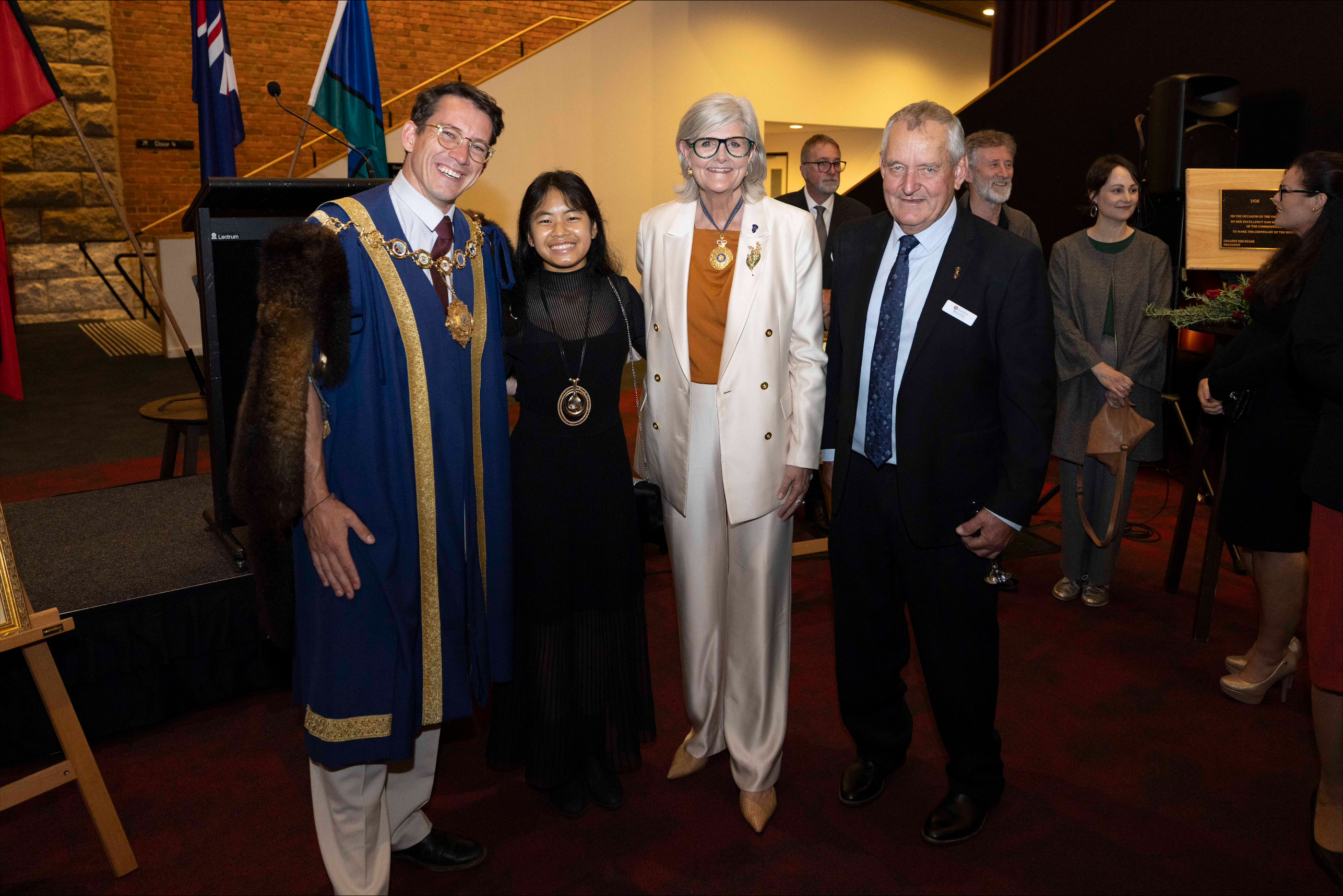
Speech delivered on Saturday, 11 April 2026, Ulumbarra Theatre, Bendigo, Victoria.
This congregation looks absolutely glorious, and I couldn’t be more delighted to be invited to address you this evening, as Tim has already done and as the Mayor has done.
I’d like to also acknowledge Justice Warren, the Traditional Owners of the land on which we are gathered tonight. I pay my respects to their Elders past and present, and I extend that respect to all First Nations people who are joining us. I also want to say thank you to Aunty Sandy, who I met this afternoon.
We shared her story as one of the Elders here at one of the very special visits I made to a women’s shelter, and she shared much of the First Nations story of this place. I’m very grateful to her.
I have had the most magnificent day in Bendigo. So, thank you, Bendigo, and to every one of you who has made our visit simply glorious. It is a real delight. It is a real privilege for me, as your Governor-General and as Patron of Legacy Australia, to celebrate the centenary of Legacy Bendigo and to, hopefully tonight, meet more of you and hear more of the stories of the Bendigo community and of the legatees.
Of course, I want to acknowledge a few people: Councillor Thomas Prince, the Mayor of the City of Greater Bendigo, and your councillors; Dr Mark Lenox OAM CSM, Chairman and Director of Legacy Australia; and of course Don Kent, President of the Legacy Bendigo Club, particularly for that very emotional, stirring and appropriate history, which was wonderful for us all to reflect on.
I just can’t overstate how Legacy Bendigo is not just here, but across the state, across the country. I’m so appreciative of the work that’s gone into that history for us and how much it means to you and the legatees, to all the recipients and to everyone here this evening. Thank you so much for that wonderful survey of Legacy Bendigo.
I also want to acknowledge all the legatees who are here this evening — many of you, some of the 100 legatees that Dom spoke about. I will just pull out Judy Perry, because this morning’s time together at the Bendigo Club, and to hear the story of a father inducting a daughter as President and now Secretary, and the people I met this morning at Legacy Bendigo — which I’ll speak about in a moment — was very special.
I want to acknowledge everybody here who is part of the generosity of this city, whether you’re a legatee or you support Legacy in the work of Legacy Bendigo. And I heard that the Young Citizen of the Year is also here. I’d like to acknowledge — where is the young… there you are. I want to acknowledge the Young Citizen here, and I hope we get to chat later and hear what it’s like to be a young person here in the City of Bendigo.
Now, you’ve just heard some of what I will say just in summary, but celebrating your centenary this year, Legacy Bendigo is one of the oldest Legacy clubs in Australia. Don’s just explained to us why that’s the case. Melbourne’s was, of course, founded first in 1923, and Geelong, Ballarat and Bendigo came next — 1923, 1925, and as we know, 1926 for Bendigo, 100 years ago.
John’s already done such a great job, so I’ll just do a little bit of summary. These clubs all began, as we know, in the first decade after World War I. About 4,000 men went to that war from Bendigo, out of a population of less than 35,000. It’s worth resting on that statistic — the sheer volume of men who travelled out of this city to serve our nation.
Of those men, 499 lost their lives in the Great War — more than Bendigo has lost in any other conflict. Many hundreds more, as we know, returned home injured and scarred, physically and psychologically. It was those families that Legacy was formed to care for 100 years ago.
We’ve heard the reason behind that — the meeting of the men, the creation of the legatees, and the fundraising that then occurred. But when you’ve lost that many men from a city as important as Bendigo, it’s clear that stepping up made a huge difference in the lives of so many. It’s the veterans and families that mattered to those first founders, and that Legacy Bendigo has been caring for ever since.
As Governor-General, Commander-in-chief of the Australian Defence Force, and the proud daughter of a veteran — my father served in the Australian Army’s Royal Corps of Signals for almost 40 years — it’s important that I’m here with you on this occasion. I was brought up as a service child, with profound respect for service and for the families and communities that enable our service men and women to perform their roles in defence of us.
Wherever I see Legacy — and I see it here in Bendigo — I see service, and I see the extraordinary generosity of the veteran community and everyone who has supported that community, in the interest of taking care of those who sacrifice so much.
Sometimes I talk about the fact that I often wear poppies. I’m not wearing one tonight, but during the course of the year I often do. The ones that are most precious to me are those that are sent to me by people who craft them and give them to me — often veterans, veterans’ family members, legatees who crochet or knit them as a mark of respect.
Men and women send me these poppies, and I’m always so thrilled to receive them — handcrafted and sent to me with such care and respect for those whose lives have been lost and for those who’ve stayed and who need support.
I get these tokens of respect from all over the country: from Legacy clubs, from CWA, View Clubs, and increasingly from many youth organisations. And this reminds me of the spirit of generosity and remembrance that sits across the Australian community, often inspired by the movement of legatees.
Today has been tremendously uplifting. It showed me the beauty of your city and the spirit of community that flourishes here. Not only the legatees — all of you ensure that people feel they belong here and are so very welcome here. I’ve experienced that with my team all day.
High tea this morning at Legacy House with many of the widows, together with legatees, was an exceptional way to start my day here with you all. To sit with those wonderful women and to know that their capacity to remain active community citizens has been largely due to the work of Legacy — making sure that, as they’ve lost their husbands and are coping with a new life, whether that loss was months ago or years ago, they are brought together by Legacy as a community — is something I know matters deeply to all of them.
I spoke to every one of those widows, and we spoke fondly about what Legacy and the legatees have done to make sure they belong, and that they’ve got a lot to look forward to. Some of them were over 100; some were celebrating 95th birthdays. They put their health and wellbeing largely down to Legacy Bendigo.
It was a very special way to start the day, and it reminded me of the stories and experiences of Legacy support that I hear all over the country — particularly at Government House in Canberra, where a highlight on our calendar is the annual high teas we host for our local Legacy war widows. Their stories were the same as the women’s this morning — the grateful experience of Legacy support during very difficult times.
And I see that across the community I grew up in. My mother unfortunately did not live to become a widow — my dad is still alive — but my mum’s health failed a few years ago. I love talking with my dad, who is now 92, about the work of Legacy for widows and women who no longer have their husbands. I know how profoundly important that is.
And increasingly it’s not just those women — it’s their families, their children. Sometimes it’s not physical health; it’s the psychological support and the sense of belonging at the heart of that care. And here in Bendigo, I know there’s always a legatee putting out a hand of care and kindness exactly when it’s needed.
Now, I did do a couple of other things today before coming back to Legacy tonight. After that beautiful morning with Legacy Bendigo, I went off as a footy tragic and joined the locals to watch Sandhurst take on Broadford across all of the divisions.
It was a wonderful highlight. There’s nothing like local footy for a footy tragic like me. You’ll know I’m an avid fan of the AFL competition. My Swannies — I’m hoping have just done the Suns over at Gather Round in South Australia.
You’ll all have your teams in that competition, but as much fun as that gives us, there’s nothing like being at a local ground with locals watching local footy. Sometimes it’s about old rivalries being evened out; teams very close in their capacity. And of course, you know the story for these two teams is a bit different. Sandhurst has had a bit of domination at the moment, but how could you not encourage Broadford — coming back into the competition, coming here to Bendigo, a new president, making sure the future of footy is guaranteed, doing the hard work even when the scorelines are difficult to take home at the end of the day.
It was wonderful, and I loved the fact that there were many legatees standing around watching footy, because legatees — like everyone — are just part of the citizenry here.
I then spent some time this afternoon at Annie North. Some of you will know about Annie North — a profoundly moving insight into the generosity and deep care at the heart of your community. One of Bendigo’s crisis refuge and transitional support services for women and children escaping family and domestic violence.
That was care at its most needed. I was seeing children being supported and women whose lives are being rebuilt, and it felt like the same kind of work as the legatees — just stepping up and always helping.
Then there were the deep roots of Bendigo’s multicultural success, which emerged when I toured the Golden Dragon Museum. I know the team is here, and I want to thank them for that marvellous tour and the understanding it gave me of the extraordinary, layered history of your vibrant city.
So, you can see I’ve had a lot to reflect on today, and we’ve only scratched the surface.