


Speech delivered on 25 July 2026 at Abbey Lea, Dublin
Good evening, everybody.
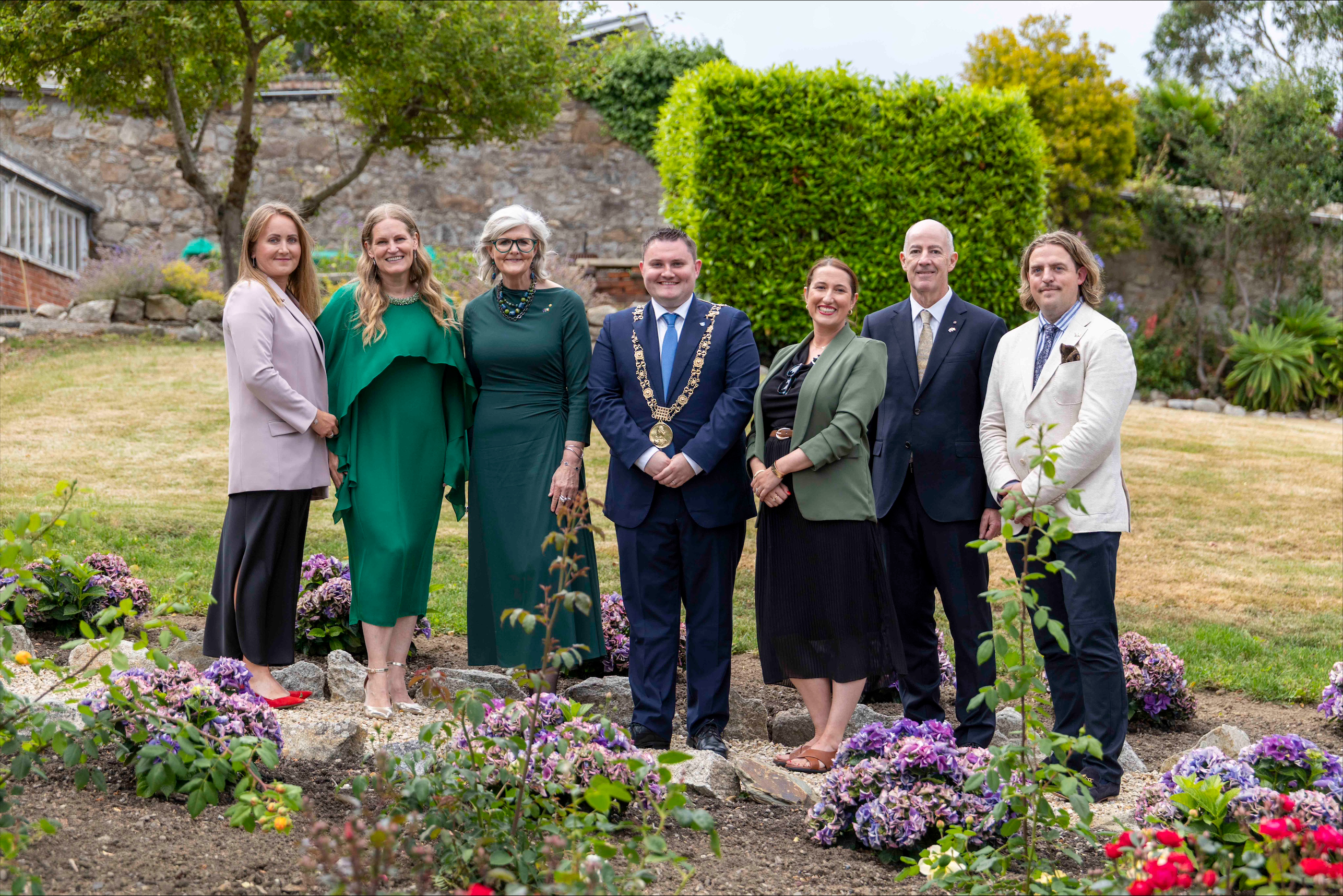
You look so splendid here in this wonderful garden.
Thank you all for joining us tonight.
I would like to acknowledge
- Her Excellency Chantelle Taylor, Ambassador of Australia to Ireland, and Ashley Grimmer
- Emer Higgins, Minister of State for Children, Disability and Equality
- Daryl Barron, Lord Mayor of Dublin, thank you f or your beautiful words of welcome. It means a great deal to be welcomed by you on this first official visit to Dublin.
- I’d also like to acknowledge all the artists, historians, members of communities and representatives – you form a lovely picture of the cross-section of community here in Ireland, and the wonderful ties between our two countries.
It was a great privilege to unveil the plaque commemorating the courage and resilience of those young women.
It was nice to be reminded about where women have gone subsequently, and I loved your comment, Your Excellency, about how the first women, the Irish Roses, would think about where women are today, particularly in the relationship between our two great nations.
It is a special joy to be here with you at Abbey Lea, Australia’s home in Ireland for just over 60 years.
Over the decades, the people of Ireland and Australia have gathered here so often to celebrate and pay tribute to the deep and enduring relationship between our two countries.
It is so fitting that remembrance of the Irish Roses will find an enduring home here, in this beautiful garden.
Thank you, Olga, for the imagination and skill you have brought to realising Australia’s commitment to always remember the young women of Ireland – mná na hÉireann – who came to Australia in the nineteenth and early twentieth centuries to build new lives in a new land.
The story of the these roses reminds me of many of the roses we have planted at Government House in Yarralumla in Canberra.
Each of those gardens, which were planted many, many decades ago, hold a special presence and appropriate reflection for people from all over the world, including the Gallipoli rose we planted for those that we lost in the First World War.
Roses seem to do something about helping us remember over time, and I’m sure this rose garden over time will be simply glorious and a wonderful tribute.
As we celebrate their contribution to Australia, we also acknowledge, in the country that farewelled them, that Ireland’s history so often tells of the sorrow of the emigrant, and the grief of those left behind.
In this place of remembrance, in the words of the great Eavan Boland in her poem ‘The Emigrant Irish’, we
‘imagine how they stood there, what they stood with, / that their possessions may become our power’.
For Australia, those who came from Ireland have ever been our power – and we are right to celebrate and honour them both here and back in my home.
Simeon, who sadly couldn’t join me on the trip, and I are delighted to be in Ireland in 2026, especially, to mark the 80th anniversary of diplomatic relations between Australia and Ireland.
Of course, diplomacy is a pillar of the modern relationship between our two countries.
But it does not stand alone.
Before it, beside it, strengthening it, are the indelible bonds between our people – the heart song of generations, of friendship and family, that we pay tribute to tonight with this beautiful rose garden.
Former President Mary McAleese once described heritage as a great resource.
It brings ways of seeing, doing and understanding that guide us on the path to the future.
As a nation, we tell our stories through our braided strength that emerged from 65,000 years of continuous Indigenous history, culture and attachment to our continent …
… the adoption of principles of democracy and institutions of government …
… and the extraordinary success achieved through our 80 years of migrants and refugees from every part of the world with diverse histories, cultures and backgrounds. Our strong, successful, modern nation is buttressed by these elements which we celebrate.
For Australia, heritage is a profound resource and is the essence of who we are.
The Irish Roses brought with them a rich heritage to join in the building of a nation of peace, prosperity, safety and freedom.
In their names … the Bridgets, Margarets, Elizas, Ellens, Marys, and so many, many others … we hear the poetry of Ireland …
… and in their lives we find an important part of the story of Australia.
Their descendants – the one in ten Australians who claim Irish heritage – and those who have come after – the scholars and sportspeople, business leaders and industrialists, carers and teachers, artists and innovators living across the country – including the youthful branch of the Irish diaspora settled in what has come to be known as County Coogee and County Bondi in Sydney – have enriched Australia beyond measure.
In fact, I reflect on the fact that, after that terrible tragedy in Bondi in December of last year, so many of the young Irish people living in Bondi and Coogee were some of the first to respond to the needs of many of those who were caught up in that terrible incident.
They have been an enduring support long after that event, and it says so much about the strength of the community, and their integration into Australia.
It is the Irish who have shown great care to the Jewish community and to all of those who are affected by that terrible, terrible tragedy.
And we could not imagine Australia without the proud history and presence of the Irish people.
Not long before leaving Australia, Simeon and I had the great pleasure of attending a reception in Sydney hosted by Her Excellency Fiona Flood, Ireland’s Ambassador to Australia, on the eve of the Nations Championship between Australia and Ireland.
And, then, on the following day, we were thrilled to watch the match itself.
As you all know, the final result didn’t go Australia’s way, but the spirit of competition, camaraderie and craic that filled the stadium was a powerful reminder of our enduring friendship and respect for one another.
Here at Abbey Lea, the Irish Roses Memorial Garden is a reminder that the freedoms we enjoy today – to compete on an international stage, to exchange ideas, to explore our place in the world through our diplomatic relationship, to advance our economies, to pursue progress on sustainable principles – started with the seeds of courage, resilience and hope planted by those young Irish women who gave so much of themselves to Australia.
Because of them, we are bound to one another as friends and family.
Some of you may know the story of 13-year-old Austin Appleby, who earlier this year swam four kilometres through rough waters off the south-west coast of Western Australia, and ran another two kilometres to raise the alarm after his mother and young brother and sister were stranded in the sea.
The son of an Irish Rose – his mother, Joanne, was born in Country Monaghan – Austin’s heroism has been celebrated in Australia and Ireland and around the world.
After his act of extraordinary courage, hope and endurance, Austin said his mantra was ‘I have to keep on going’.
I’m sure the original Irish Roses would see their tenacity, courage and resilience embodied in the works of that young man.
In a spirit of gratitude and respect for their resolute determination, I am honoured and delighted to dedicate this garden to the memory of the Irish Roses.