



3 November 2026
Good morning, everybody.
I'd like to start by thanking the children of Concord West Rhodes Preschool for that beautiful and unique Acknowledgement of Country.
It's also lovely to be welcomed by the hymn by the military wives this morning. My father was a soldier, and my mother, who passed, was a military wife. I know the service of military wives. So, it's lovely to see you this morning in full voice.
It is a great honour for us to gather here on Wangal land and I acknowledge the Wangal, the Traditional Owners of this Country, and pay my respects to their Elders, past and present, and acknowledge all First Nations people attending today.
I acknowledge The Honourable Richard Marles MP, Acting Prime Minister; the Most Reverend Rochus Josef Tatamai MSC DD CSM, Archbishop of Rabaul; the Honourable David Harris MP, New South Wales Minister for Veterans; Tim James MP, Shadow Minister for Veterans; Senator Jessica Collins and Sally Sitou MP, Member for Reid; Stephanie Di Pasqua MP, Member for Drummoyne; and Jason Yat-Sen Li MP, Member for Strathfield.
Jason, you delivered the VP address here in August this year. And I went and read your remarks. I want to thank you for the poignant reminder that you made here that these remembrance days are not simply about victories, but about the price always paid for peace, and that stories of journeys home are also important. It was a very, very important speech, and I enjoyed reading it in preparation for today.
Councillor Michael Megna, Mayor of the City of Canada Bay; the Honourable Dennis Cowdroy AO KC, former Federal Court Justice; and the Honourable Charlie Lynn OAM OL, former member of the New South Wales Legislative Council; Commodore Ben Hissink CSC, Deputy Fleet Commander, Royal Australian Navy; and Wing Commander Kylie Cimen, representing the Chief of Air Force.
The Consuls-General and representatives of so many countries today: the United Kingdom, the United States, Papua New Guinea, New Zealand, Timor-Leste, Turkiye, and all of those representing our diplomatic corps here today.
Archdeacon Andrew Nixon, representing the Department of Veterans’ Affairs; Friar Graeme Malone, Chaplain of Concord Hospital.
Thank you, Jennifer Collins AM, Chair of the Kokoda Track Memorial Walkway, for welcoming us, together with Carole-Anne Priest, Deputy Chair; Alice Kang OAM, your Honorary Secretary, and Ray James OAM, and all your members of the Board.
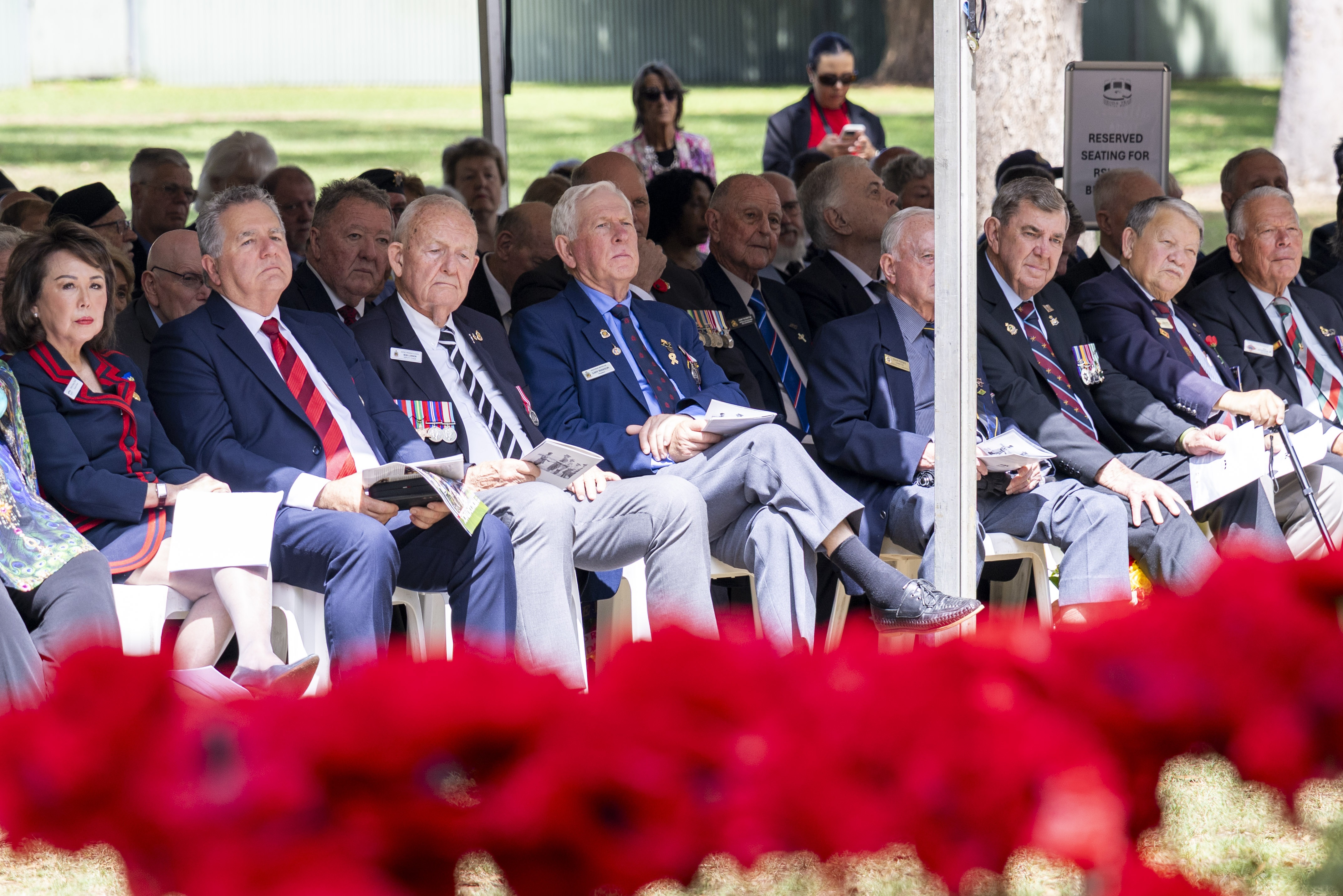
And of course, I acknowledge all veterans, all current serving Australian Defence personnel and their families, representatives from Papua New Guinea, and the members of the choirs and those that we will hear later in the morning. I also acknowledge the many volunteers, supporters, the wonderful students we have here from so many schools. Everyone joining us for this very special remembrance today is a very special guest.
It is a privilege to make my first visit to the Kokoda Track Memorial Walkway as your patron, and to join everyone here to commemorate this important 30th anniversary year.
Just before we commenced proceedings, I joined the Archbishop, Jennifer and the Deputy Prime Minister to unveil a new granite plinth outside the Ralph Honner Kokoda Education Centre. I hope you all have a chance to look at it as you depart today.
It contains soil brought here last year from the Kokoda Plateau in Papua New Guinea. Of course, it was there 84 years ago today that Australian soldiers raised the flag after re-entering Kokoda the previous day.
They had fought through months of retreat and advance across the rugged and sometimes almost impenetrable Owen Stanley Range- through steep country, mud and rain, hunger, fever and disease, against an enemy determined to reach Port Moresby. Now, of course, those soldiers not only battled the enemy, but the very track itself.
The flag-raising moment was a moment of hope, achieved at an enormously high cost, and the fighting was far from over. Around 56,000 Australians, at one time or another, served in the PNG region, including in sea or air operations, and as we know, more than 600 Australians lost their lives in the Kokoda fighting. Today, once again, we honour them. We honour those who returned carrying deep wounds and memories of war, and the families whose lives were changed forever by war, service and loss.
And this has never been simply a story about Australian loss, but an important remembrance too of the loss to the Papuan people. The men who fed, guided, carried, and cared for Australian troops throughout the campaign. Men and their families and communities who also sacrificed themselves for us. And every story matters.
One of the photographs captured just up where the catafalque party is situated is the iconic black and white image taken by George Silk, a photographer for the Australian Government on Christmas Day in 1942. I know that you, like many Australians, know it so well.
The photo captures Private George ‘Dick’ Whittington who had been shot above the eye the previous day. He was holding a stick and could not see his way along the track. Beside him, Raphael Oimbari, a Papuan man, held his arm and guided him through the tall Kunai grass towards medical help.
George Silk stepped aside and took a photograph without stopping them. Then, as they moved on, he went back to ask the wounded soldier his name. Now, George Whittington survived his wound captured in that photo but tragically died of scrub typhus just seven weeks later.
The photograph became one of the most recognised images of the war in Papua. But in a telling reminder of our duty to always pay respect to those who stand alongside us, for decades the name of the man guiding him, Raphael Oimbari, was missing from its story.
Australia owes an enduring debt of gratitude to the Papuan and New Guinean people. They served as soldiers and carriers, cared selflessly for the sick and wounded, and sustained Australian forces through extraordinary danger and unimaginable hardship. The war brought great suffering, not only to their lives but to their communities and families across generations. And it's this understanding that's part of what binds us today as great friends. It does mean a great deal that so many people have come together today, including representatives of Papua New Guinea and Australia, veterans, families, and people who, for the past 30 years, have cared so much for this splendid Walkway. It speaks to the place Kokoda continues to hold in the history of both our countries, and the enduring friendship between our peoples.
Archbishop, thank you for joining us in remembrance today. I know that Cardinal Ribat was unable to attend – I'd like you to send my best wishes to the Cardinal as he recovers from illness.
Just a few months ago, I hosted 10 church and faith leaders from Papua New Guinea at Admiralty House, where we discussed friendship, community, and the warmth between our two nations. To our friends from Papua New Guinea, thank you for being here and sharing this important moment of remembrance with us.
Now, when the Walkway opened 30 years ago, a veteran named Bill Jollie was filmed looking at another image in the granite, the Golden Stairway. He said, "I've walked that stairway twice. Once going up and once coming down.” He knew that climb in a way the rest of us never can.
Alan Kinkade, then general manager of Concord Hospital, had a straightforward reason for helping create the walkway, as the hospital had changed from a veterans' hospital to a public hospital. “I wanted to do something for the veterans,” he recalled.
And with the RSL, the council, Rotary, and many others, that wish took shape as a memorial that so many people could visit and have visited, learn from, and pass through in their everyday lives between Rhodes Station and the hospital.
When the rose garden opened in 1998, it was dedicated particularly to the medical and nursing teams. The roses have been chosen for their fragrance as well as their colour, because, as we have all experienced, a scent can bring back memories in an instant. It was a fitting tribute here beside a hospital that cared for so many veterans and continues to care for so many people today. And of course, the walkway has continued to grow.
The Ralph Honner Kokoda Education Centre helps young Australians discover the experiences of those who served and understand the lives and often complex stories behind the photographs and the names. I know that you all know one of the people who devoted years to sharing those stories. It was Reg Chard.
Reg served in Papua with the 55/53 Battalion, enlisting at the tender age of 18. And for years, he volunteered here as a guide, giving his time and sharing his experience with so many school children and many other visitors. Sadly, he passed away earlier this year, just in July, Australia's last surviving Kokoda campaign veteran.
At the service held here just in September to honour him and his 102 years of life, children from North Strathfield Public School sang, and the students from Bethany College read a poem. It was a fitting and moving tribute to a man who had given so much of his time to helping young people understand a war that he had uniquely lived through, a campaign where he, along with his mates, marched through the rugged mountains, survived repeated bouts of malaria, and endured the fiercest of fighting.
The Faces of Kokoda installation we've heard of this morning continues that work. Hundreds of photographs bring us face to face with young Australians whose lives were cut terribly short, and remind us of the families and communities who mourned and continue to mourn them.
To the guides, researchers, gardeners, donors, and volunteers who have so carefully tended this place for 30 years, on behalf of everybody here, thank you for your grace and the care you've taken with these stories. Our responsibility extends to the veterans and families living with the consequences of service today, and to those who care for them, including the Papuan families and communities.
More than 30 years after George Whittington died, his widow asked for help to find the Papuan man who had guided her husband towards safety that Christmas Day. She wanted to thank him personally. And it was her search that helped return Raphael's name to the photograph. But I guess you'd all agree with me, it shouldn't have taken decades to find Raphael and his story.
On this day, on Kokoda Day, it's important that the sometimes-romanticized depictions of the so-called Fuzzy Wuzzy Angels, the Papuans who supported us, are also balanced with the complex truth of what life was really like for those Papuan carriers during the Kokoda campaign of 1942, and many other subsequent campaigns.
On the 75th anniversary of Kokoda, our two countries published Voices from the War: Papua New Guinean Stories of the Kokoda Campaign. In preparation for today, I read many of those stories. As then Prime Minister Malcolm Turnbull said in its introduction:
"It is a time to remember the heroic contributions of our Papua New Guinean neighbours. Kokoda is a monument to the courage, endurance, mateship, and sacrifice that both Australians and Papuans displayed in this time of immense peril.”
But perhaps one of the most important references in that document sits with a Papuan Jerry Dimuda from Kagi Village, and he said this after the campaign finished:
"The Australians made a strong commitment with us on that day that they will be together, and their friendship will be together, and they will keep helping us in any way they can in the future. The Australians said they will become our brothers and sisters forever.”
So, we know that to be true. We know that to be true today. The enduring warmth of our friendship with Papua New Guinea, which we see so clearly deepening all the time, starts in this place. For 30 years, this Walkway has helped Australians find exactly that – that relationship and the people. It has helped us to learn and to understand, to know these people by name, and to give thanks, and to keep the resilience of these servicemen alive for all future generations.
Today, we speak all of their names with gratitude and honesty and care. Whether it's George Whittington, Raphael Oimbari, or the hundreds and hundreds of others that we can learn of here.
We will always honour all who served, those who never came home, and the families who carry their stories and legacy in their lives forever.
Lest we forget.