



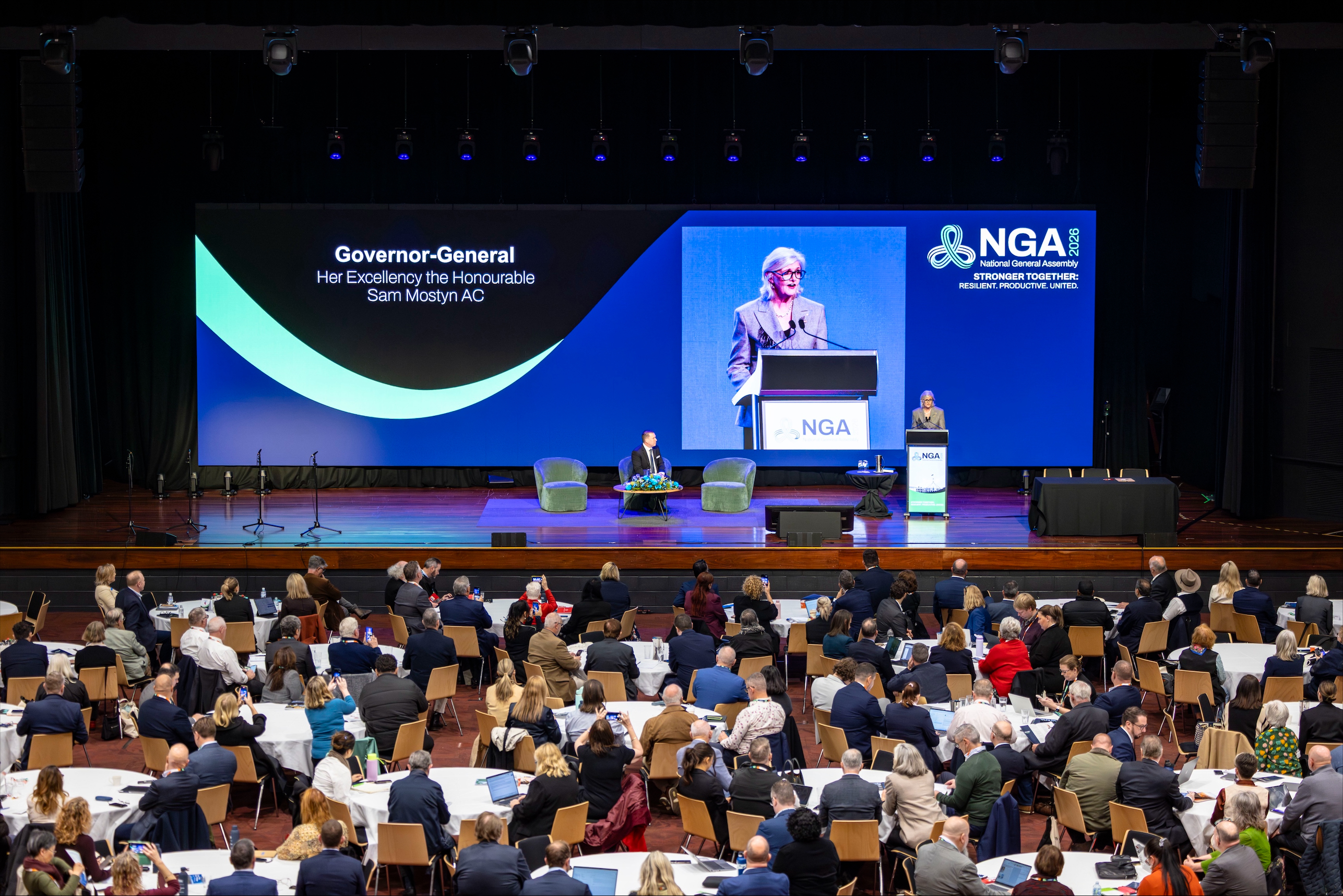
Speech delivered on 24 June 2026 at the National Convention Centre Canberra
Good morning, everybody. It's wonderful to join you here this morning. Thank you, Amy, for introducing the assembly. And I will note that the choir leaving is the Woden Valley Choir. Apart from being born in Canberra Hospital, I went to Woden Valley High School, which doesn't exist anymore, but you have the first Canberra-born Governor-General joining you today. My father was in the Australian Army, so I was born here, but we traveled around this country as children a lot before coming back here later in my schooling.
I want to acknowledge Paul House's beautiful welcome to country. You may not know that Paul was involved in quite a serious car accident only five weeks ago, where he broke his sternum and fractured many of his ribs, and I found it extraordinary to watch him with that incredible circular breathing, which took so much out of his lungs to welcome you here today.
I pay my respects to the traditional owners of this land, and pay my respects to their elders, past and present, and extend that to all First Nations people here, including First Nations mayors and councilors who are joining us here from all over the country. I don't think she's here yet, but I would like to acknowledge the Honourable Catherine King, MP, Minister for Infrastructure, Transport, Regional Government, and Local Government, our President, of course, Mayor Matt Burnett, who's been shepherding me here this morning. Thank you very much, Matt. We've just met the ALGA board. It's wonderful to see you all highlighted this morning. Wonderful to welcome you all here together with mayors, shire presidents, councilors, local government leaders from all across the country who are joining us this morning. It's a very cold Canberra week. It's been very foggy and frosty this week, but the days are quite magnificent. So, I'm sure if you get a chance to wander around in the afternoon and early evening, it is a glorious time of the year to be here.
I'm really, really proud to be back here at ALGA, at your National Assembly. This is my third time opening the assembly, and in the two years that I've been doing that, I have become known to many of you in this room, many of you are my newfound mentors, friends, and teachers. You've been my hosts. You've generously invited me into your communities, and it's a privilege to have you all back here a third time in my term to see you doing the hard work of leadership of local government.
ALGA’s National General Assembly in 2024 marked my first public engagement as your Governor-General. I spoke to you just a day after my swearing-in on 1 July that year, and I believe now that that was a prescient way to begin my term with all of you who are so deeply embedded in community, representing over 500 councils from across our truly extraordinary country, and as you all know so well, and we'll be talking about over the next few days, you are the closest people to the community, and when the community needs help, it's councils and local government that usually they come to first.
For me, returning here every year has become a very important and meaningful touchstone. It's a tangible opportunity for me to renew my commitment to put care, kindness, and respect at the centre of my privileged role as your 28th Governor-General. Care, kindness, and respect was the promise I made in my swearing-in speech in the Senate, and was reaffirmed in my opening address to you all in 2024. Since then, I have been welcomed into almost 30 of your LGAs formally, but I've spoken or spent time with so many more of you in both the toughest and the best of times. I've often met with you and your communities at extremely vulnerable moments, moments of recovery surrounded by the debris of natural disasters, or dealing with challenges of a wide range of issues.
They're the things you'll be discussing at the assembly, rising costs, ongoing fuel insecurity, and that very real increased expectation of your communities and constantly being asked to do more. Most recently, I was in the Colac Otway and Surf Coast Shires in Victoria, hearing from mayors Jason Schram and Libby Stapleton, deep in recovery from a summer of fires and devastating floods, and in March, the Council of Mount Isa and Greg Campbell, Mayor of Cloncurry, welcomed me to a region that, like so many of you around the country, had also been impacted by extreme weather and flooding.
Of course, Steve Krieg, Mayor of Lismore, keeps me updated on the restoration and reinvigoration of his city centre, and I'm so pleased to hear that the council has recently moved back into its historic CBD building after four years since those devastating floods and storm events that have happened ever since. Steve and his deputies were the first mayors I engaged with as I became your Governor-General, on the recommendation of my predecessor, General Hurley, well known to many of you, who took a deep interest in all of your communities. I also saw all that devastation on a visit to Taree, learning about the extraordinary community efforts to respond to the catastrophic events there, and of course, there are droughts across New South Wales, and weather impacts across the entirety of our nation, the entire continent, which has continued to define our country this year.
Then there are social issues. Earlier this week, I was so honoured to spend time with Asta Hill, Mayor of Alice Springs, hearing about her exceptionally complex work alongside local organisations to support and unify a community in trauma after the heartbreak and death of a child in the most horrific of circumstances. As it is with all of you, it has been humbling to watch Asta's leadership through that crisis and her fierce dedication to the community-led change in the narrative of her town, Alice Springs. I know you're involved in this work in all of your towns and cities and local government areas.
I've also spent time with many of you, also in good times, and there are so many good times in your communities, at your community celebrations and ceremonies, local shows, and in the memorable moments that you've treated me very specially. I'll never forget the chilly sunrise swim in Bass Straight with Teeny Brumby, Mayor of Burney, and there have been many other occasions like that. I'm not always jumping into ice baths, although recent weeks might suggest otherwise – if you follow the AFL and the Big Freeze.
At the other end of the continent, I spent time in January with Elsie Seriat OAM, Mayor of Thursday Island. We where there to commemorate their 90 year anniversary of one of the great strikes for equality, the 1936 Torres Strait Maritime Strike. I’ve been to Bendigo, Fairfield, Darwin, Brisbane, been all over the place, learning about the impacts of algal bloom in the Eyre Peninsula across South Australia, and so many, many more places.
I traveled to Uluru for the 40th anniversary of the handover of the National Park. I spent time in central Australia and across many of the desert regions, across every part of this country. I don't need to tell you this, it is you, it's local government leaders who share with me the heart of the Australian community, so most importantly today, I want to thank you all for helping me to do my work.
Your generosity, your insights, and your capacity to solve problems and listen to your communities is so instructive, but ultimately inspiring. I've also had the privilege and opportunity to meet with some other ambassadors of yours, the young students from your schools who come to Government House as part of the Canberra Civics Tours. At last count, I've had over 40,000 come to Government House in the past two years, and I try to see as many of those young people as I can when I'm there in Canberra. Here in Canberra, yesterday were three schools from across Queensland, Victoria, and New South Wales. Last week, a school from Humpty Doo in the Northern Territory, and from Western Australia and Tasmania. They come from everywhere, and often in the middle of winter from very warm places. But don't worry about it. They're here to show up and learn about civics and our democracy.
Now, your theme for your national gathering is timely, and I think vital: Stronger together, resilient, productive, and united. Approaching the midpoint of my term, I now have an even clearer view of how much it matters to all of us, just how resilient and productive and united you are. It's essential in keeping our country running and keeping communities together. So, good luck with the work across the assembly in Canberra.
As leaders of local government, you live and work among the people you represent from all levels of government, all of them I can think of, it is you who are most trusted by our citizens. Your proximity to your communities when people trust you because they know you and they know that you know them and you're always standing right beside them. And given the complexity of the world we now live in, I wouldn't mind just speaking for a moment about civics and social cohesion in an increasingly uncertain, volatile local and global environment, you all know this. We're experiencing it particularly online, but it is creeping into the real world, a world where truth is contested, where division feels more acute, and the loss of civility in our discourse has become so much more frequent. Ultimately, and sadly, we are experiencing a diminished public trust in our democracy and institutions. I get to feel that up close as I travel around the country, and people give me feedback. When I'm invited into your communities, I see the remarkable work that you're doing in leading that to counter division and to strengthen your communities, and to build hope. You do embody the respect that we need to see, you respect each other, you respect your communities, and you respect across cultures, faith and beliefs. You show up in a way that teaches the rest of us what it means to be truly inclusive, and whether it's seeing people from all walks of life working together, often in terribly extreme situations, volunteering to rebuild homes and community facilities, caring for the vulnerable, providing counseling services to those in distress, and feeding some of the workers who are helping the community to regain some kind of normality after any number of crises. These are the stories that tell me that our communities are strong and connected, and they reflect incredibly the diversity which does capture a modern nation that you see so vibrantly in the middle of your communities. However, since we were here last year, Australia has tragically experienced the worst terrorist attack in our history on our soil, an abhorrent antisemitic attack on a peaceful Hanukkah celebration at Bondi Beach in December that shattered our sense of safety and harmony. As an important counterpoint to that terrible time, in the days after Bondi, we saw the unbreakable strength of the kindness, care, and respect and resolve that I believe continues to sit at the heart of the Australian people, and we saw it in local government. Mayors from across New South Wales, from the Tweed Valley to the Riverina to the South Coast, came to Bondi to show solidarity with Waverley Mayor Will Namesh and Inner West Mayor Darcy Boone. Now, six months on, that patient, difficult work of rebuilding a community, but rebuilding respect for each other, rejecting hate and violence, and giving hope rather than fear. That work goes on, and it is predominantly led by local government, by people like you, and people in this room today. Of course, just six months on, our thoughts must continue to be with all of those affected by Bondi, not those just living there, but everyone across the country affected by the impact of that terrible tragedy. I've been pleased to see so many multi-faith communities stepping up, and I've hosted many multi-faith round tables with leaders, including local government, to try to re-establish the unity that I believe does define us. Like Will and Darcy, you are all now on the front lines of rebuilding cohesion and trust in your communities. You engage in the hard work of social repair and inclusion, things you have always done. These things I know can take a personal toll, particularly on those of you in this room.
Sometimes I call you to have a chat to see how you're going to make sure that people giving these strengths to others can take strength from those who particularly care about the work that you do, and if you don't mind, I'll keep making those calls to you from time to time to check in and see how you're going, particularly in times of crisis. You do what is necessary to respond to your communities, and they rely heavily on you, and as questions of the strength of our social fabric grow, I've had to do a bit of searching myself about my role, and I've looked back at some of the work of my predecessors to better understand what does a modern Governor-General do in times like this. I looked for periods where Australia faced times of uncertainty, where healing was required in the long shadow of other events, not terrorist attacks, but other things that have happened, and I looked at the long shadow of the 1975 constitutional crisis, which some of you, most of you, will be aware of: 50 years ago, the sacking of a prime minister, and in the shadow of that, in the years that followed, it was Sir Zelman Cowen, the second Jewish man to hold the office of Governor-General, that began to look for the main purpose of the office of the Governor-General. I've been rereading Sir Zelman’s memoirs to give me a sense of his life. I've read the memoirs of most of our Governors-General, but this one in particular seemed important, particularly after Bondi. In 1977, shortly before he took office, Sir Zelman said that he hoped that during his term that he could bring a touch of healing to the country and its people. He wrote in his memoir that he saw that the Governor-General has an opportunity to promote unity and heal division up against what he called the passions and rancor of partisan politics. He said, if you think that seemed a bit too grand, the Governor-General can, at least in his words, help to preserve and keep and repair the spirit of consensus in our society. Now, you'd all know I have no politics, I have no policies, I don't make grants of money, but his point about pushing back on the passions and rancor of partisan politics is something he is suggesting that someone in my role must do, and must do actively throughout his term. He said that the Governor-General interprets the nation to itself by offering encouragement and recognition to many Australians, some of whom are not very powerful or visible, and to the efforts of people and groups who work constructively to improve life in Australia, that's what I'm doing here. I'm acknowledging the work that you all do to improve the lives of Australians, and to make sure that I stand up and tell your stories wherever I go. He also spoke of presenting the light and shade of the country back to itself, not shirking the hard stories and the hard conversations that need to be raised in the hope that it helps everyone to find unity and have those conversations with respect for each other. Now, how I do my role is with the help of you, it's local government leaders, so many in this room that I do that presenting of light and shade, and hoping to bring unity and peace, and a little bit of that work that Sir Zelman spoke so clearly about back in the 70s. I'm honoured to work in partnership with you to ensure that we all aim to strengthen our social fabric and ask the questions: Who is not being heard? Who's being overlooked here? What are we doing to bring people actively together when the pressure to be apart is so strong? How do we take care of the most vulnerable with compassion? As another predecessor of mine, Sir William Deane, still alive here at 95 in Canberra, reminds me regularly must also be a clear focus for leaders and for a Governor-General. So it's through your eyes I've come to understand Australian communities and their need for the office of the Governor-General to be modern, visible, and connected, and for me to be present always to show care and to listen deeply.
Of course, it's the young people in your communities. It also gives me, along with you, great hope, and I see them pushing back against a lack of interest in our democracy, and seeing them increasingly engaged in civics and our grand narrative of democracy. I saw that in the National Youth Forum, the Young Mayors program and initiatives like Bendigo’s innovative Youth Council, which provides advice to the city of Greater Bendigo Council on plans, strategies, policies, and projects. I go out to the forum later. I'll be so delighted to see more of those young mayors and to see Ethan Tate as he leaves as being the outgoing young mayor of the McKay Youth Council.
Just this weekend, on Saturday, and seeing in the audience, I welcomed Mohammed Semra, Mayor of Maribyrnong, to Government House to celebrate the stories of Refugee Week just passed. Mohammed’s story as the first Australian mayor from Sub-Saharan Africa is in itself a reason to celebrate, and we were together at Government House with a couple of hundred people to celebrate the launch of the new Australia Post stamp, celebrating the 1 million refugees Australia has welcomed to this country over the past decades that have added to the extraordinary success of this nation. Now the mayor at 27 years old, Mohammed is probably the best evidence that providing opportunity for young people to participate in civics is a major investment in the strong future of our much revered and admired democracy, and I know you all care about that. Now, as you commence your deliberations, and they're tough, over the next couple of days, I want to encourage you with your commitment to your resilience and productivity and your unity, as well as your government.
While we might tell ourselves stories of divisions at a national level, they kind of lead the news most days. It's in your communities where I see the extraordinary work led by you, where care and kindness define so much of your resilience and recovery in your unity, these are the stories I will tell the country as I do my job. I know it gives hope and optimism to a country that has so much to celebrate. If we choose to do that, a modern, diverse, successful democracy, which has clear values at its core and unity without uniformity at its centre. And as I close, I have two favors to ask you. First, could you please ensure that the unheralded, passionate community builders in your world are nominated for Australian Honours? There's far too many people in your world that do not carry the pin of the Australian Honours system. It's 50 years old, and although some might think there's people here in Canberra who just choose people, it all starts with a community nomination. We've done a lot of work at Government House in the last two years to speed up that process and to make sure those nominated get to their investitures much more quickly than they do today, but there's far too few of the community builders I see here in the honours list today, so please. Nominate and celebrate, it's an important part of how we can truly show the strength of this country. Secondly, and this may be a little bit more, ask a bit more of you, I'm going to give you a couple of projects that I started a little while ago. I started it with the late James Valentine AM. Those of you in New South Wales will know him as an ABC radio host in Radio Sydney, but he was deeply connected to the community of Sydney and New South Wales. Sadly, he passed away. He chose voluntary assisted dying and did that as such, such a brave way, and shared that story with Australia. He was a dear friend, and in the last year of his life, I was working with him to get his advice as to how the Governor General could engage on the story of what makes us Australian, and to push back against descriptions of us that might say anything other than how great we are. What he asked me to do, and suggested I could do, was create the Governor-General's Wattle Day photoboard, called My Favorite Australian.
He suggested that entries from around the country would be judged on what the picture says about the person that someone has chosen as their favorite Australian, and what it says about Australia today. It could be a family member, it could be a stranger, it could be anyone, but a photo that would capture what it was about the values of that person that told us about Australia over time. He thought it could be a people's census and a portrait of our magnificent nation in real time, and perhaps I could award the winning photograph on our National Wattle Day, on the first of September, a day itself, which is described in legislation as a day of renewal and strength from the first day of spring. I'm really happy to say, I did receive some support from Councilor Steve Allen Bellingham, Mayor Bellingham, who said he's up for it, and I'm happy to hear from anyone else who'd like to help us celebrate Wattle Day in this way over the years ahead. I think Sir Zelman Cowen would be happy to see that we were trying to understand ourselves and maybe it's a very modern way. A small quip before I move to opening your National General Assembly, there seem to be big futures for mayors, whether it's a mayor of Queensland that becomes a minister, a significant minister in the current government, or a UK mayor becoming Prime Minister. So, I suspect I'm talking to a group of people who have big ambitions, maybe. If that's the case, you will take great stories of great understanding of our nation that might restore trust in national stories and projects. That's seeing it here. So, thank you for letting me chat to you this morning, and share a few thoughts. I'll be back again next year if I'm invited, but right now it is my great privilege and honour to open for the third time the Australian Council of Local Government National General Assembly of 2026.