



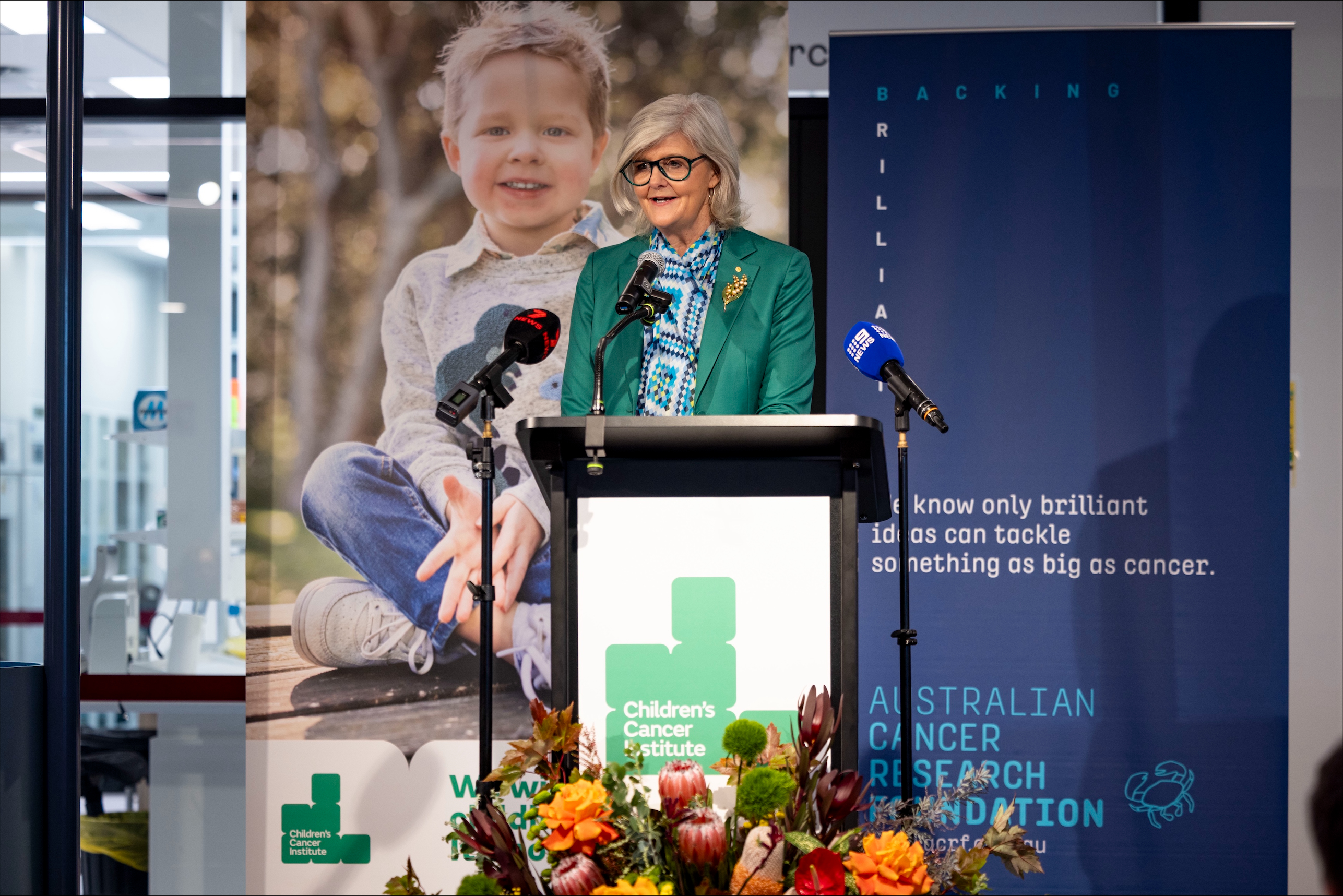
Speech delivered on 18 May 2026 at the Minderoo Children's Comprehensive Cancer Centre, Randwick
It really is a wonderful morning to be here. The best way to start the week, looking at all of you, that brings us here together for this wonderful opening. As Ness has done, I also acknowledge that we are on the lands of the Gadigal people of the Eora Nation, and I want to pay my respects to Elders, past and present, and acknowledge all Aboriginal or Torres Strait Islander people here today. And yes, thank you for that very lovely reference to why that matters. Just yesterday, throughout the weekend, I was in Brisbane, and I visited an exceptional Aboriginal-controlled medical centre, primary care as well, all about the absolute centrality of the patient and the family of the patients, and I see that in the work here as well. So it was lovely to hear you acknowledge that. I also want to acknowledge Tim Cooper. Tim, we know each other well through the ACRF. It is wonderful to see the powerful work that is going on here today. Kerry Strydom, the CEO of the ACRF, Professor Paul Eckert, Professor Louis Chesler. Professor Ness Tyrrell, the program director for the Zero Childhood Cancer National Precision and Commencement Program, Rob Salomon and Chelsea Mayoh, the chief investigators and research program leads, and really today, very importantly, the researchers, the clinicians, the supporters of the ACRF and the Children's Cancer Institute, everyone here from the CCI, and the entire ASpIRe team, I'm really delighted to be here with you at the Minderoo Children's Comprehensive Cancer Center, Australia's first dedicated comprehensive cancer center for children. It's also so wonderful to see many of those involved in the ACRF who I last saw at dinner last year to celebrate the extraordinary philanthropy and generosity of Australians that come through that fund.
Today is a very special day, opening these new facilities and launching the Spatial Immune Oncology Research Program for childhood cancer, ASpIRe. As patron of both ACRF and the Children's Cancer Institute, I have the opportunity to often see firsthand what becomes possible when generous Australians back dedication and discovery, and today we see what is possible when philanthropy, clinical expertise, and scientific ambition come together with a single steadfast purpose, giving children the very best chance of having childhoods and long and healthy lives. Now, as you all know in this room better than most, in Australia around 1,000 children and young people are diagnosed with cancer every year.
Thanks to research and treatment, about 85% of those children will survive and will survive well. About three children in Australia today sadly die of cancer every week. For many survivors, the journey does not end when treatment ends. Around 70% will face serious long-term effects that will shape the rest of their lives, and of course, behind every statistic is a child, a beautiful young person with their own story, their own hopes, and dreams about what they want to be and what they want to do when they grow up, supported by loving families and communities. Every child and their families deserve the very best possible treatment and care while living with cancer. Dedicated childhood cancer research matters profoundly. We know that childhood cancers are not simply adult cancers in smaller bodies, they can be different in their causes, in the way they grow and spread, and in how they respond to treatment. That difference demands focus, specialized capability, and sustained investment. The Children's Cancer Institute has been devoted to that mission for decades.
Founded in 1976 by two parents of children with cancer, it remains the only independent medical research institute in Australia, wholly dedicated to curing childhood cancer for more than 40 years. The work has been driven by a commitment to translation, turning discoveries in the lab into safer, more effective treatments in hospitals as quickly as possible, in partnership with clinicians and health services here and around the world. Now, as patron of CCI and the Australian Cancer Research Foundation, I know that you share together the urgency and optimism that brings us here today. As the branding says, ACRF backs brilliance, it backs bold ideas, and equips brilliant researchers with cutting-edge technology, because breakthroughs rarely happen by accident. They happen when talented people have the tools, the time, and the really confident support that they can follow to understand the evidence, ask better questions, and test new possibilities. And I've seen the emotional response of researchers receiving their grants, these are transformative moments to know that there's long-term funding that invests in them and brings them certainty and confidence, so they can be brilliant.
Today, the launch of ASpIRe represents exactly this kind of remarkable, purposeful long-term investment. Immunotherapy is, of course, one of the most promising approaches in modern cancer treatment, and while delivering some truly remarkable results in some adult cancers, successes are yet to be matched across childhood cancers. ASpIRe will change that. You are introducing world-ready capabilities to Australia, including technologies that can point researchers towards smarter, more targeted, and ultimately more personalized immunotherapies for children. Importantly, ASpIRe is being integrated with the Zero Childhood Cancer Program, your world-leading precision medicine initiative, available for all children diagnosed with cancer in Australia, through a partnership between the Children's Cancer Institute and Sydney Children's Hospital. That integration matters deeply, and it means strengthening Australia's contribution to global child cancer research by generating knowledge that can be shared, tested, and built upon internationally. None of this happens without people, scientists with curiosity and courage, clinicians who translate research into care, technical specialists who keep complex platforms running, and crucially, donors and supporters who choose to invest in hope, and I want to thank and acknowledge every one of you who are involved in any part of that here today. That's why we get to this point now.
As many of you would know, when I was sworn in as your Governor-General, almost two years ago, I promised to put care, kindness, and respect at the core of everything that I do, together with my team, and that's care for one another, care for those who do the caring of others, that's all of you today, care for our restoring continent and its environmental riches, and everything gives us another way of saying care for Country, care for civics and institutions, and today it's these institutions that we're celebrating, and care the way in which we discuss and debate really tough issues without judgment, anger, or violence.
So, for me, this center, and all the work that you do, embodies care in its most critical and impactful form, care for the long-term future of Australia's children and Australia's contribution to the most rigorous and accountable medical research. Some suggested to me that choosing care as a center of my work was a soft option, that care is something that we do that's in a more feminine structure, and whilst care is always wrapped in a soft form, always delivered with great love and empathy, care of this kind, the care that you're involved in, is anything but soft. It's hard, it's relentless. It requires commitment. It's got to be accountable. It has to show up. It's got to reform itself. It's got to keep turning around. That is care that's the most difficult form. That is what delivers the great, the greatest joy, particularly today to the children and families that will be the beneficiaries of this wonderful, wonderful place. So today I am so delighted to open doors to new possibilities, possibilities for treatments that are more effective and less harmful, for children to spend more time learning and playing and less time being patients, more time simply just kids with all that they entail, and for the families to imagine futures for their children with less anxiety and much more certainty, to be part of the joy of their children's childhood. So today I am honored to officially launch the ACRF Special Immune Oncology Research Program for Childhood Cancer, ASpIRe. Congratulations to absolutely everybody who has played a part in bringing us here today for this wonderful moment.