


Speech delivered on 25 March 2026 at Government House.
Oh, wow. I mean, really, wow. To greet all of you students here at Government House was like receiving rock stars.
I get to see and go to so many amazing places and do some amazing things, but I remember the convention from last year and I couldn’t wait to see all of you. This is probably one of our favourite events to host here at Government House, because we get to see the future of the country. We get to see so much enthusiasm and interest in why we are the great democracy that we are.
But to see the future of Australia gathered together is one of the coolest things ever for a Governor-General. So, I welcome you all here.
How many of you have arrived here for the very first time? Most of you — great. I love that, because you’re exploring this place for the very first time. Even if you’ve been to Canberra, you may not have had the chance to come in here and see what we do at Government House.
I want to start by acknowledging that we meet on the traditional lands of the Ngunnawal people and pay my deep respects to their Elders past and present. And I want to let you know that whenever we have guests — particularly international guests arriving, or ambassadors being credentialled — we always have smoking ceremonies.
Just last week, we welcomed the King and Queen of Denmark, King Frederik and Queen Mary, and they received the most beautiful smoking ceremony to welcome them back to Australia. We do that so that Ngunnawal people can speak about this country, welcome those who come from other countries, and talk about attachment to country, kinship, care for country, and all the things we have learned over 65,000 years.
And then, from all of you who have families from other parts of the world, being part of our shared story, I want to acknowledge any First Nations people who are here this evening. All of you bring through your Elders, your attachment to country, and your cultural practices. This is a place we try to present as a place of peace and welcome, where everyone belongs.
People often talk about the formal role of Government House. It is the official residence of the Governor-General, but I like to think of it as a place where every Australian — and every international visitor — should come and spend time, see what we’re trying to do with the house, and hear the stories we tell.
As you walk around the ground floor, look in the rooms, look at the art. You’ll see we’re trying to tell a story from 65,000 years ago right through to contemporary Australia. And what makes me really excited is that all of you are part of the National Schools Constitutional Convention.
It’s wonderful that you’re joined by your teachers, who understand just how important civic and constitutional rights and responsibilities are in the story of our great democracy. Around the world right now, I can’t imagine a time when caring about democracy has been more important.
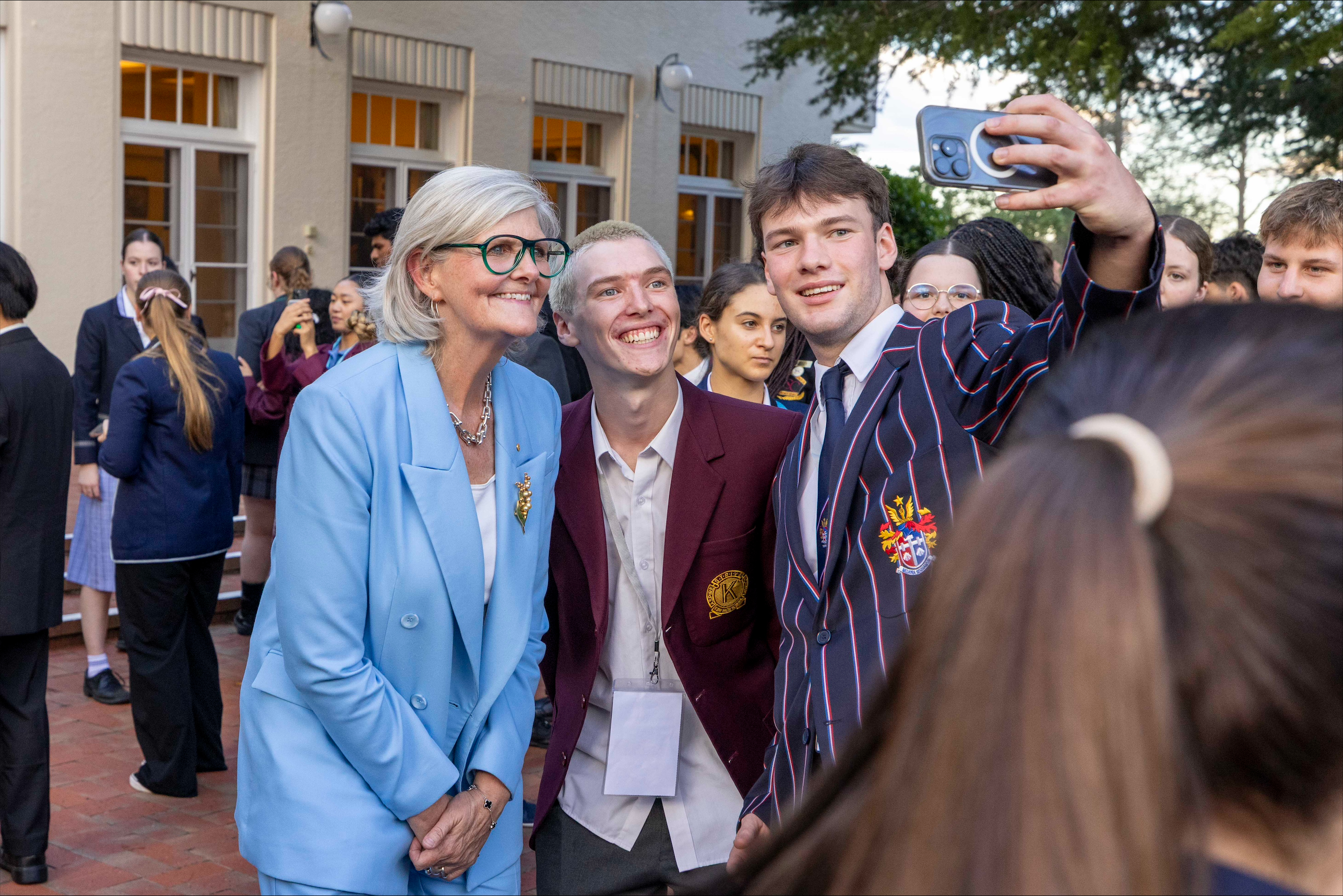
Some of you commented on my brooch. The brooch I’m wearing today is the wattle. The wattle is Australia’s national floral emblem. The Crown and the wattle together are the insignia of the Office of the Governor-General.
Last year, we travelled as guests of government to Mongolia. It wasn’t expected — until we were invited — and many people asked why we were going to Mongolia. When I arrived, the President of Mongolia presented me with this beautiful brooch.
The reason he gave it to me was this: Mongolia is a small democracy sitting between two autocracies — China and Russia. It claims its place as a modern democracy, but it has worked hard to build and protect its democratic institutions.
Thirty years ago, Australia worked with Mongolia to establish the Australia Awards, bringing Mongolian students to Australia to study at our universities — to study our democracy, leadership and governance. Today, more than 200 Mongolians who studied here now lead their country’s cultural institutions, political system and democratic organisations. They’re called ‘Mozzies.’
When I was being briefed before the visit, people told me how Mongolians talk constantly about watching Australian democracy over the past 30 years — taking heart from it at a time when the world is losing democracies, people’s rights and sovereignty.
And here you are, at a Constitutional Convention, celebrating our democracy. I’m glad you’re doing it here in Australia, because not as many people outside this room are doing it — yet people around the world are looking at us and recognising how precious what we have really is.
Tonight, I would normally acknowledge distinguished guests. But instead, I want to say this: every one of you students here is the most distinguished guest in the house this evening.
When I was sworn in, in the Senate, by our Chief Justice of the High Court, I said to all Australians that I would put care, kindness and respect at the centre of everything I do — care for each other, care for those who care for others, care for our country and its environmental riches, and care for our institutions and our democracy.
Importantly, I spoke about care for how we discuss and debate the really tough issues of our time — without anger, without violence, without judgement — always wrestling with the idea, not the person, and always showing respect.
Your time in Canberra over the last few days, building up to your referendum and sitting week, has been thrilling to watch. You are engaging deeply with what it means to be a constitutional democracy. For me, that is a profound act of care.
I thank you for caring about democracy, and for taking time out as young Australians to think about what it means to be part of this great system. I can see it in your work, your compassion, and in how seriously you take your role as representatives of your schools.
I think — collectively — you know more about how our democracy works, how our Constitution works, and how my role fits within it, than almost any group that comes through Government House. And you should be very proud of that.
You understand that my powers are strictly defined within our system of responsible and representative government. You know I have no politics, no policies, and no money. But you also understand that my constitutional duties are part of the checks and balances that give our system stability, credibility and public confidence.
So, to be gathered with you here is genuinely special for me. I want to hear what you think we should be doing, what I should be talking about around the country to encourage more people to care deeply about the Constitution. What you take back to your communities is something I can learn from and help amplify.
As you move around Government House tonight, you’ll see places where I perform my constitutional and ceremonial functions. Every fortnight, I receive credentials from new ambassadors. Today, I hosted the President of the Federated States of Micronesia. The colour here is from the Micronesian flag.
Interestingly, in the Pacific Islands Forum, Australia and Micronesia are the only two federations. We have much to share.
Down the corridor, you’ll come to a place of deep historical significance. It marks the events of 1975 — now 50 years ago — involving a former Governor-General, Sir John Kerr. You’ve been talking about these events today with Professor Anne Twomey.
Ahead of last year’s anniversary, Professor Twomey joined me in that study for a podcast, where we discussed why it happened, whether it could happen again, and what I would do in similar circumstances. You can find that online.
The chair in that study is the one Sir John Kerr sat in. If you want to sit in it and take a photo, you’re very welcome to. Beside the desk is the framed copy of the letter he handed to Gough Whitlam.
Those actions, taken in 1975, continue to occupy the minds of constitutional lawyers, historians and commentators.
I studied law here at ANU. One of my closest friends from law school is Robert Beech-Jones — now a Justice of the High Court of Australia. We always knew he’d get there.
I look at all of you and wonder where you will end up in our democracy. The work you’re doing here matters. The question you’re examining — whether the Constitution could be amended to prevent the Senate from blocking supply — goes right to the heart of 1975.
As you’ve heard today, supply was central to that crisis. Money bills create a unique constitutional tension.
Any constitutional change in Australia must be informed and engaged. Australians can’t be told to care — they must be invited to be curious and to think deeply about why our constitutional democracy matters.
You’re having serious debates this week about section 53, and your convention is taking place at a precious — and dangerous — time for democracy. Just yesterday, I participated in the launch of the McKinnon Foundation’s State of Australia’s Democracy report.
While most Australians believe our democracy is strong, it faces significant risks — from misinformation, disinformation, and growing apathy. That collision may be one of the greatest threats to constitutional stability.
Eighty-five per cent of Australians believe we need more civic education in schools. Two thirds want stronger protections against misinformation and foreign interference. The McKinnon Foundation’s campaign, Democracy Counts, is something you may want to engage with.
We need young people who care about the Constitution, who live in the world we are building, to help protect it.
Sir William Deane, a former Governor-General, once described our Constitution as a “living force”. Such powerful words. Not a static document, but something that must be held, cared for, and renewed by each generation.
And tonight, that living force is in your hands — because you turned up to show how much you care about our country and its future and for the place of our Constitution at the heart of our democracy.