


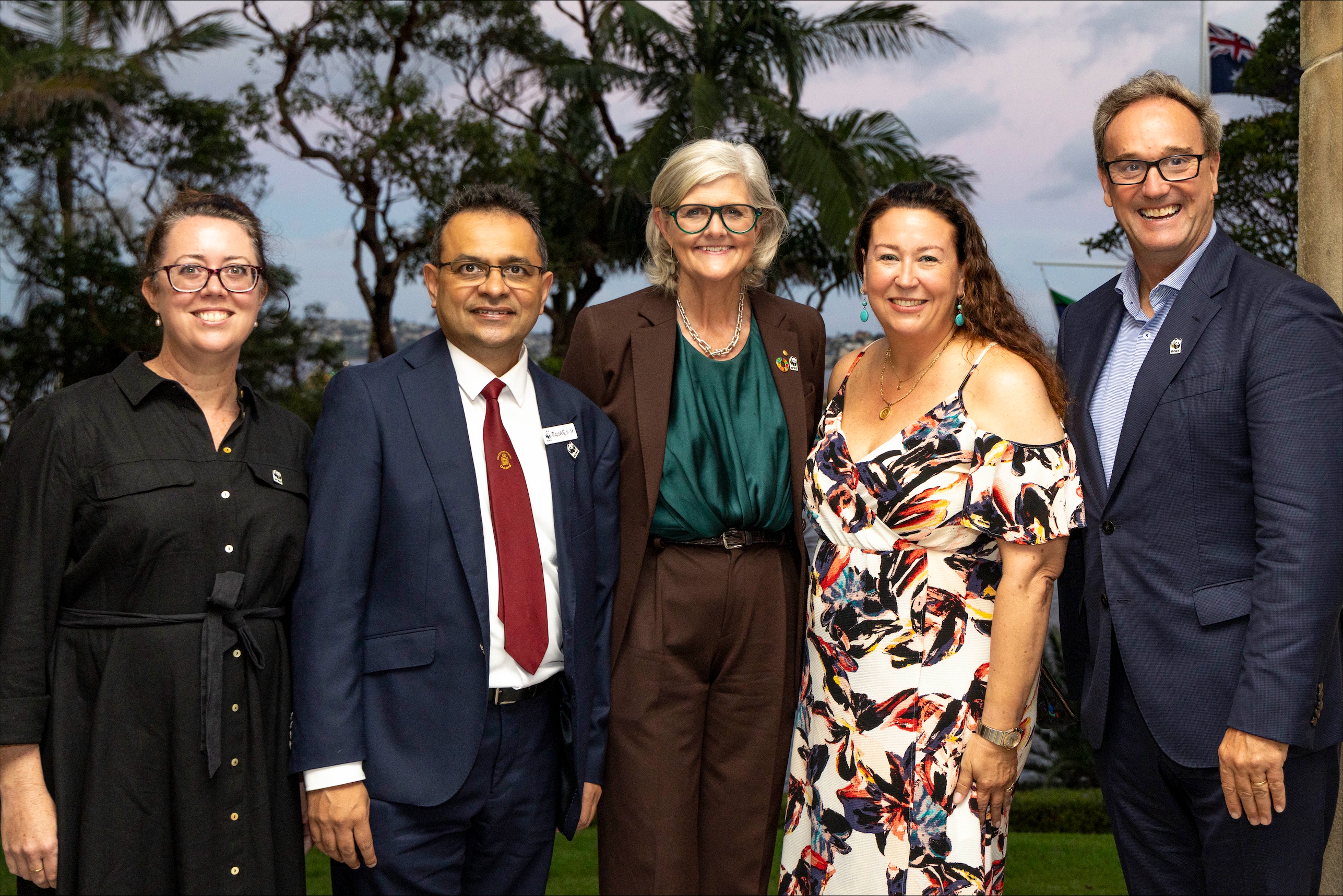
Speech delivered on 23 March 2026 at Admiralty House, Sydney.
This is truly astonishing to look around this room and see the world represented here tonight. It's very exciting for us to host you here at Admiralty House. We like to think of this as a place of peace and deep welcome, where absolutely everybody belongs. I would like to start though by acknowledging that we are on the lands of the traditional owners of this country, the Cammeraygal people. And I pay my respects to the Cammeraygal elders, past and present. I also acknowledge that just across the water, you spent the day on Gadigal land, and you would have been welcomed, I'm sure, or had Gadigal land acknowledged for you as part of your day's proceedings. And the proximity of Cammeraygal and Gadigal land is significant, and it's interesting to think about what this place was like before there were any of these buildings and this infrastructure. And First Peoples were here looking after this country with such care and generosity and have been doing so ever since. I want to pay my respects to all Aboriginal and First Nations people who are in the audience tonight. Karen Mundine, who's representing Reconciliation Australia, it's really important that we always acknowledge Country, particularly given the work that you are all involved in, in the preservation of nature and species, things that we can learn from First Nations people. I'm deeply conscious that these waterways, these lands, have been taken care of for tens of thousands of years, and we are the great beneficiaries of that care.
I acknowledge Dermot O'Gorman, the CEO, and Judy Slatya, President of WWF Australia. You're both old mates, I know very, very well. It's wonderful to welcome you here in the roles I know that you love most at WWF.
Dr Adil Najam, Global President, WWF International, together with all of the country leaders who are here tonight, you are all very important and special guests here tonight, representing your nations, representing your commitment to nature and to biodiversity and species preservation, the fact that you are gathered here in Sydney in Australia, makes me feel very, very proud that WWF has gathered you all here in this beautiful part of the world.
Mr. Greg Bourne, Councilor and Director of the Climate Council. We've known each other a long time too. We've served on many things together. It's wonderful to see you here tonight, and many other people that I felt around this room, people that I spent so much time with, and so it's like an old school week for me to welcome so many here. I've mentioned Karen Mundine, but I want to say that specifically, as CEO of Reconciliation Australia, the work you do Karen is endless and indefatigable, and it's wonderful to see you here tonight.
Will Nankervis, Australia's ambassador for Climate Change. Distinguished guests, of which you are all distinguished from right across the world, particularly the Asia Pacific region, but from further afield as well. Welcome to this rather splendid place, Admiralty House. It is a place of peace, where we believe everyone is welcome and belongs, and where we make space for conversation and events which speak to the things that we care deeply about.
You'll see in this room quite a bit of art, and there's art throughout the ground floor of this house when we break you're very welcome to come outside and rejoin that spectacular sunset and to look at the glorious view of the harbor, but you're also welcome to wander around the ground floor of Admiralty house, and to look into the various rooms, you can see the art and artifacts that decorate the walls or in the cupboards and on the bookshelves. We're trying to tell a story about Australia's long and deep history, from Ray Ken, the piece of art that's down the end, which is from the APY lands, very, very significant lands in Australia, all the way through to Mrs. Yunupingu, who's around here, who was painting the Harbor Bridge when she visited here for reconciliation meetings. But as you wander around the house, you'll see many paintings. The one right at the very front by Paddy Bedford, from West Australia. It's a men's medicine pocket painting. It's a healing painting. And then in the main dining room, the room is anchored by a painting by Mavis Ngallametta. And she was from Cape York up in far North Queensland. It's also a healing painting. And if you spend time looking at these paintings and their stories, I hope you feel a piece that's embedded in those paintings telling that story, and they are joined by many modern pieces that tell the story of modern Australia and the Australia we've now become.
I'm really delighted this is my first engagement as patron of WWF Australia, and it is such a significant event. Thank you for inviting me to do this. It's the beginning of your week of the WWF Asia Pacific leadership gathering, together as conservation leaders, partners, and supporters of WWF across the region. This is a vital week that you're participating in. Your week of sharing stories, impact, innovation and collaboration from across the Asia Pacific and across the world will highlight the vital place of collective action in driving systemic change for nature.
Just one week ago, I had the great privilege, together with my husband Simeon, who you met tonight, we hosted their Majesties King Frederick and Queen Mary of Denmark on their historic first state visit to Australia as the King and Queen of Denmark. Now their visit, the Australians will know, was partly a homecoming for Australian-born Queen Mary, but more importantly, I believe it was an opportunity to connect with Australia, and to connect Australia and Denmark on conservation, renewable energy transition and energy efficiency. The theme of their business delegation – they brought over 100 people representing 50 companies – was partnering for a green, secure and sustainable tomorrow. It was quite some homecoming for Queen Mary and said so much about Denmark's commitment to sustainability. I didn't need to remind them that the glorious Opera House across the water was designed by a Danish man, Jorn Utzon. And before it was opened in 1973 it was a very difficult time for its construction, but Jorn held to his vision of what would be one of the most spectacular pieces of architecture on the planet. He delivered on that. And today that is a six-star Green Star Building, a World Heritage Site, and has some of the most impressive sustainability issues and outcomes imaginable for a cultural site of such significance. So, if I need to be reminded about sustainability quite often, the Sydney Opera House is right there.
Now sustainability is a concept I think we now encounter almost everywhere, but you all know it was much less ubiquitous when many of us first committed ourselves to this work. For me, it was more than 20 years ago, including time at the Climate Council, ClimateWorks Australia, the Business Sustainability Partnership, Cambridge University, and later the Australian Climate Change Authority. But it was much less common in 1961 when the WWF was first founded.
That was a remarkably far-sighted response to nature loss, and the beginning of an enduring vision of restoration. For more than six decades, WWF has stood as the world's largest and most respected independent conservation organization with a global network spanning over 100 countries, you have all championed a simple but profound mission to stop the degradation of our planet's natural environment and to restore nature's balance.
WWF Australia was established in 1978 and since then, has grown into an iconic national force for conservation here on what I regard now as our fragile island continent. As you all know over those decades, the need for environmental protection has only grown more urgent. You know, better than any group I could imagine, that nature loss and climate change are accelerating here in Australia and elsewhere. But we know that here and across our entire region, freshwater species have declined by a staggering 85%, land species by 69% and marine populations by 56%. And globally, this is all the tough news that you deal with all the time, we witnessed an average decline of 73% of wildlife populations since 1970. As WWF International Director General, Kirsten Schuijt has said, ‘nature is issuing a distress call.’ Well, here in Australia, we know this distress call. We know this urgency all too well.
Some of you may have read the work of Jeff Goodell. Jeff used to write for Rolling Stone magazine in the United States. He came here in 2011 to write a piece on the future of this continent. And he described Australia's unique predicament, calling us ‘the petri dish’ of climate change impact. What he meant was that we experienced every single aspect of climate change on this single continent, and we experience it every day. In other words, flooding, dryness, desertification, more extreme weather events, fires. We get it all here, often simultaneously. You could examine it all here. The Great Barrier Reef alone has endured mass coral bleaching events in five of the last ten years, and that is expected to accelerate. In the catastrophic fire season of 2019-20, which many of us will remember vividly, we lost an unfathomable 3 billion animals, and we only need to reflect on the past few months here in Australia to see the overlapping and increasingly repetitive catastrophic battering of so much of our country and the region.
Back in 2020, WWF Australia launched a $300 million plan to regenerate Australia, an unprecedented effort to restore and future-proof our landscapes and you also adopted a bold vision. Regenerate nature by 2030. Based on deep listening, including with indigenous elders and Rangers and local communities. Your strategy involves restoration of Sky Country and salt water. This means using more renewable energy restoring land and stewarding our ocean.
Here in Australia, we feel this. Our coastline touches the Indian, Pacific and Southern oceans. In fact, we have more Ocean Territory than land under our care. This was something I discussed very recently with Her Excellency, Dr Hilda Heine, the President of the Republic of the Marshall Islands when she visited Australia just last month, just prior to the Ocean Decade meeting, which we also hosted an event for here in Sydney. Her nation of islands knows the challenges of climate change and rising seas all too well. Climate action is at the forefront of everything she does in the leadership of her nation. When I met her, Simeon and I were not long back from Zenadth Kes – the Torres Strait Islands. We've had many conversations with Torres Strait Islander people about care for sea country, and it's beyond existential. We were welcomed to an island which may not and probably will not survive for the next generation. But that is where we were in January, welcomed by the traditional owners on Masig, otherwise known as Yorke Island, a tiny coral cay in the eastern-central Torres Strait. That island will disappear for the next generation. To be with the traditional owners and to understand what that means is confronting.
The ocean generates half our world's oxygen and absorbs a third of our carbon dioxide. It's the source of food, fuel, medicine, and more, and everything else I've spoken of. It is also in crisis with overfishing, rising temperatures, acidification and pollution, plastic and fertilizers. These all pose significant threats to the health and standard of the ocean, and I was able to witness that firsthand here in Australia when I visited the South Australian Research and Development Institute just last October. As well as underpinning South Australia's agriculture, food, aquatic and bio science sectors, they are one of the key scientific bodies here in Australia, focused on the algal bloom that you may have learned of that has been growing in scale and impacting South Australia.
This is the largest and most destructive algal bloom that Australia has ever experienced, and while they mostly last a few weeks, this one has lasted a year, now affecting 789 species in an area of sea twice the size of Greater Sydney. These things are consequential. The team at SARDI showed me around the wet labs and the food farms and explained that algal blooms are absolutely driven by climate change. No doubt in their minds, these are just some of those devastating petri dish impacts here in Australia that represent so much of what happens in the world.
And I don't want to stay in the gloom and the hard stuff, because all of us in this room would have to agree that we're also in one of the greatest periods of opportunity and optimism to actively change course, to reverse damage and allow lands and waters and communities to heal. And that's what WWF does.
Your purpose is to restore and regenerate the planet for everything that calls it home, to create a regenerative future that rebuilds those ecosystems, revitalizes communities, and delivers a healthier, more stable climate for us all. That vision, I think, is one of great hope, of generosity, possibility and deep care. Now, for those not from Australia. I will let you in on a secret that when I was sworn in as Australia's 28th Governor General, I promised to put care, kindness and respect at the centre of everything that we will do in this office over my five-year period. Care for each other, care for those that do the caring of others, care for our civics and institutions and for the way in which we discuss the very tough issues of our time, with our anger, rancour or judgment, always with respect and optimism.
I always add to that care for our continent and its environmental riches and everything it has given us. In other words, care for country, care for the future of those riches as their modern stewards. My optimism in making that promise is rewarded, because I see that level of care wherever I go. I see people involved in a collective action that you all represent. I discover ambitions to restore, regenerate, right across this country, and it's always to do with care for nature, care for communities.
Just early last year, I visited our 2025 Western Australians of the Year, Ian and Dianne Haggerty: quite remarkable people. They founded Natural Intelligence Farming and transformed 26,000 hectares of West Australia's wheat belt into a thriving, sustainable ecosystem, doing away with synthetic fertilizers, optimizing water use and rebuilding the soil, and they've only just got started. They're showing that sustainable farming is not only viable but has significant benefits for consumers.
And the same thing is happening in Northwest Tasmania, where the Forthside Research Facility is Australia's first dedicated net zero horticultural demonstration farm. I visited them in May last year and saw tangible examples of the hope of commercially launching viable net zero farming. Another 2025 Australian of the Year is having an impact. And that's Tasmanian Sam Thompson, founder of the climate startup Sea Forest, turning native seaweed into livestock feed, and that's just starting to boom. So, these are just some of my stories in the field, and I'm looking forward to hearing many, many more of yours tonight. There are thousands of these stories. Wherever we look, there are now exciting innovations and restorations happening. But you represent the very finest of what it takes to collaborate, and what collective effort looks like, a worldwide momentum of change, a transnational collaboration to restore every bit of our lands, waters and skies. You're making them sustainable for future generations of humans and every other thing that calls our planet home.
I'm going to finish up with a couple of reflections. I've reflected on the words of our 2026 Australian of the Year, Catherine Bennell-Pegg. She's the first astronaut to train under the Australian flag at the European Space Agency, which is our first. And if she gets up into the air, up into space, she'll be our first Australian astronaut. She speaks about something that you all know. It's called the overview effect, the cognitive shift that comes from looking back at the Earth from orbit. It's that little blue dot that we learned about so many years ago. And she says, you can't see borders from up there, just a fragile shared home and a powerful truth that we're all in this together. That is a powerful truth. It's the one that brings us together tonight to celebrate your work and brings you all for your leadership gathering to Australia this week. I want to thank you all for making that journey. Australia is a long way to come.
Thank you for your deep care, for our fragile, shared home.
And lastly, I was watching the late Jane Goodall in that extraordinary Famous Last Words broadcast after her death, the words she wanted us to listen to after she left this planet. I found her reflections compelling, that we are all here for a reason, that our lives matter and that we each choose the difference that we seek to make. We are all part of the natural world, part of mother nature, and we should not ever lose hope. To save what is beautiful on this planet, we need to think about our actions every day, as you do as leaders. She hoped that we all understood that our lives do make a difference, and that it is in our power to make that difference, whatever it might be, I know that each of you participating in this incredible leadership gathering lives this commitment not just for yourselves, but for your communities and for the world every day. I hope that by coming together tonight, and over the course of the week, you are strengthened by your time together. Thank you for everything that you do. It's consequential, and every single one of you matters deeply. The care you show our planet and our nature and everything sustains us.