


Speech delivered on 26 November 2025
I often look across Gadigal land, across Sydney Harbour, and think about the original First Nations women—fishing in boats, caring for their families, and supporting their communities in those waters. It’s a powerful reminder of the strength of women in First Nations communities—and, indeed, in communities everywhere.
I want to thank Shey. Standing up and sharing such a deeply personal story about you and your sons—and the fact that it’s been 762 days since you’ve been locked out of your own finances—sets the tone for today. These stories are real. They remain hidden until they are not, and they affect women in every part of our community.
I’m conscious that many victim-survivors are here today. I pay my respects—not only for what you’ve endured but for the courage you show in telling your stories. They’ve been hidden for far too long. I’ll say more about Anne Summers, who has brought these truths to light throughout her career.
I acknowledge Vanessa Liell for inviting me to be part of the We Rise family. I’m glad you’re here with your mum—you’ve always spoken about her strength and the women who shaped your life.
We were together in Central Australia before the referendum, speaking with Anangu women leaders of the Uluru Statement from the Heart. I’ve returned since, most recently for the 40th anniversary of the handback of Uluru and the Pitjantjatjara Women’s Council celebrations. These same issues persist—not only in Central Australia but across the country and the world.
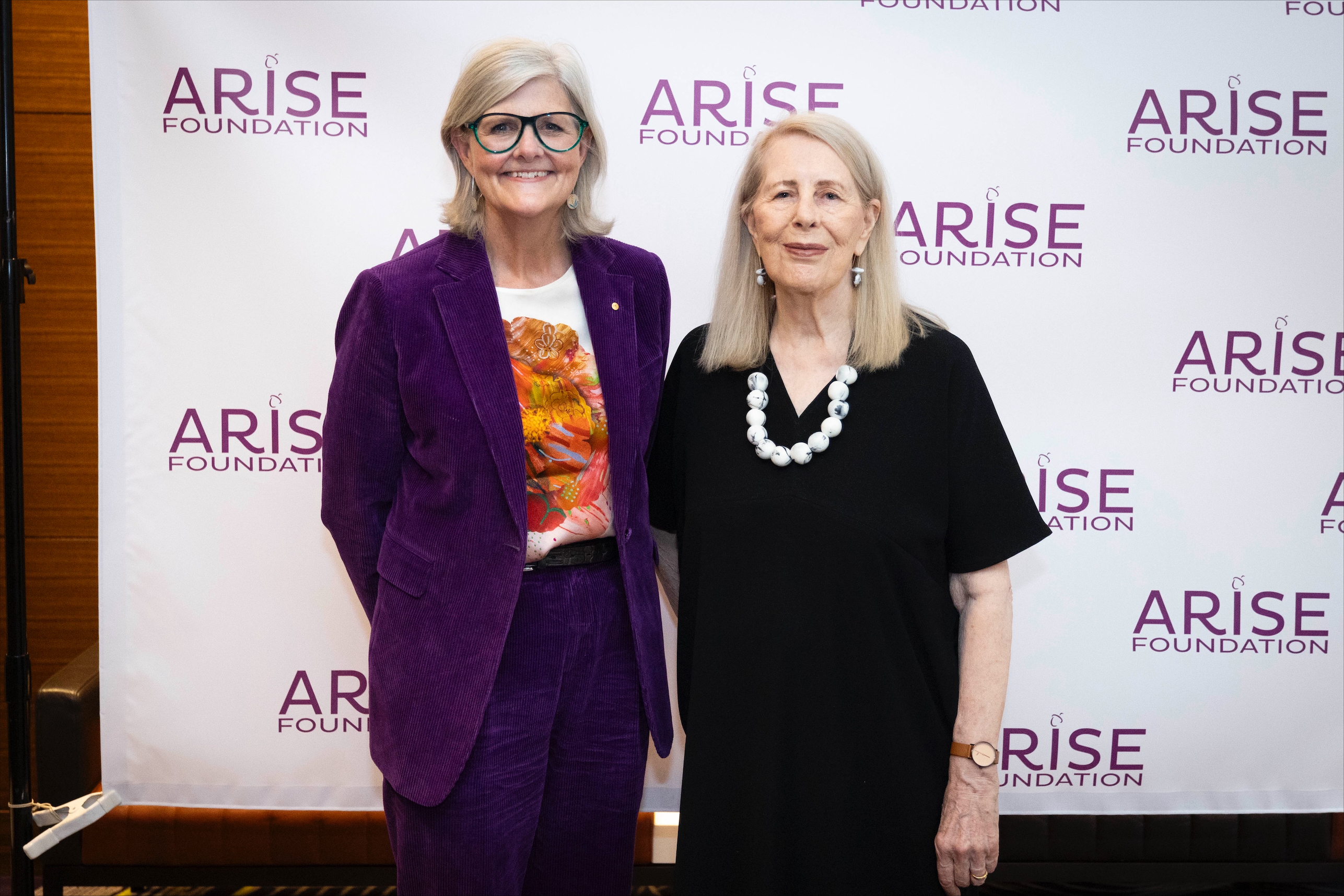
I also acknowledge Tasnia Alam Hannan and Fariha Chowdhury—not just co-CEOs but co-founders of Arise Foundation. Thank goodness for you. What you’re creating is profound and practical, and the results are here in this room and beyond. Thanks also to your advisory board—chaired by Vanessa, with Adam Coonan, Keryn Thompson, and Joe Catanzariti—and to Tarang Chawla, Commissioner for the Victorian Multicultural Commission and co-founder of Not One More Niki. And, of course, the Hon. Helen Coonan—a long-time fighter for women’s rights and a great supporter of Arise.
Now, to Anne Summers—Dr. Anne Summers AO, Professor of Domestic and Family Violence at UTS Business School. Anne is a national treasure—though she’ll hate that phrase. Author, feminist, academic, commentator—her influence is extraordinary. I knew Anne from afar until more recently, when she produced her pioneering research Violence or Poverty. That work revealed the stark choices women face: flee a dangerous home and live in poverty, or stay and endure violence. It was the first time these realities were laid bare. Women were demonized for leaving, yet no one understood why. Anne’s research changed that.
Her follow-up report, The Cost, continues to drive policy today. Anne has been uncompromising in bringing this evidence to light—starting 50 years ago with Damned Whores and God’s Police, published in 1975. That audacious, influential work remains seminal. If you haven’t read it, you should. It was recently featured in the National Library’s exhibition Living in the 70s.
There are so many people I’d like to acknowledge—I won’t, because I’d spend all my time doing that—but I see faces I know at every table. To all victim-survivors and graduates: your tenacity and courage inspire us. We’ve got your back. Now we must raise the funds to keep Arise going—so you can continue your pathways to recovery and reclaim your lives.
I’m delighted to be here on the second day of the 16 Days of Activism Against Gender Violence. Yesterday was the International Day for the Elimination of Violence Against Women and Girls. I posted a video about it—hit, as always, with criticism from those who don’t understand the power of what we’re doing here. In that video, I reflected on the World Health Organization’s first systemic study of violence against women—released in 2013. Shocking, isn’t it? Just over a decade ago. And the most disturbing finding: one in three women globally experience intimate partner violence—a number unchanged in 12 years.
Today, on Economic Abuse Awareness Day, we’re discussing the insidious nature of financial abuse—its tools of exploitation and sabotage that undermine women’s financial security and futures. One in six women in Australia experience this—and that’s likely an underestimate. The impact is profound: trapping women in damaging, unequal relationships of dependence. Anne’s research shows this deep inequality—even for women in their 60s trying to rebuild their lives. Her report on the cost of domestic violence to women’s employment and education calls education and employment “the revolution” that transformed women’s lives. Yet too often, women experiencing violence are denied access to that revolution.
Access to this revolution sits at the heart of Arise. Your commitment to creating pathways to education, employment, financial literacy, and independence for survivors of economic abuse is vital. Thank goodness for you—because this is the only way these women can reclaim their futures. And because there are so many, we need you to grow strong.
When I was sworn in as Governor-General, I promised to put care, kindness, and respect at the centre of everything I do. Some thought that was soft or feminine. But care is hard. Care takes rigor and persistence. It must be strategic, accountable, and results-driven. It must push boundaries and expose truths. That’s what Arise does. Care is also wrapped in compassion and deep engagement with others—and that’s what makes it powerful.
I love that you use data—the economic impacts of domestic violence—to drive your work. You tie evidence to aspirations in the National Plan to End Violence Against Women and Children and ask: how will we do this? By turning crisis into opportunity—giving women the skills to establish freedom from economic dependence. You stick with them until they regain agency. That’s innovative, people-centred care.
As Governor-General, I’m patron of several organizations. One is The Social Outfit—a social enterprise providing refugee and migrant women with training and employment in sewing and tailoring. They create beautiful clothes from donated deadstock fabric—sustainable and empowering. I’m wearing one of their pieces today. Once a year, they design their own fabric—this one was created by nine recently arrived women in Chester Hill. It features the ginkgo leaf, symbolizing peace, in colours representing their nations. Small things—but powerful pathways to agency.
Earlier this year, I met women at The Big Issue offices in Melbourne—packing magazines for subscribers. These women, some living in cars in their 60s, find financial security through this work. If you don’t subscribe, consider it—because it means real jobs for women who need them.
Organizations like Arise understand that employment and financial security mean safety, wellbeing, and autonomy. That’s why your work is profound and practical. As Professor Tim Jackson argues in The Care Economy, care is the first principle of human society—on which everything else is built. There is no economy without care. Care is the economy.
Arise embodies that truth. Your impact is extraordinary: 862 hours of training for more than 50 women in the past year; over 80 children now in safe, stable homes; 140 lives free from violence and financial dependency; and 172 women supported across all programs. Congratulations. It’s an honour to be here. I’ll take your message wherever I go. Thank you.