



We've just witnessed the story of why Lifeline matters and what's at the core of everything you do. Thank you, Carrie, for acknowledging Country, and I also acknowledge the Ngunnawal people, and I pay my respects to their Elders, past and present.
A bit like you, Greg, I'm an Army brat. Growing up, everything was about doing a recce, showing up on time, fixing things. You know, it was always about the practical things.
And I learned early on in my corporate career that I was a “waiting to talk” person. So in meetings, I would be waiting to insert myself into the conversation to fix things. And it was Aboriginal people, particularly Aboriginal women, who first pointed that out to me when I was a young executive—that it's no fun sitting in the room with someone who's waiting to talk.
Deep listening is an act of care, and you only ever hear people when you are in the act of deep listening. And I think Aboriginal people—that's part of the culture of First Nations people—to actually sit and listen and often be very comfortable in silence.
I've learned to become very comfortable in those silent moments where you allow others to bring forward what they have to say. I think what you all embody is that act of deep listening and being there all the time, no matter what the circumstances are. And you also learn new skills to become those deep listeners.
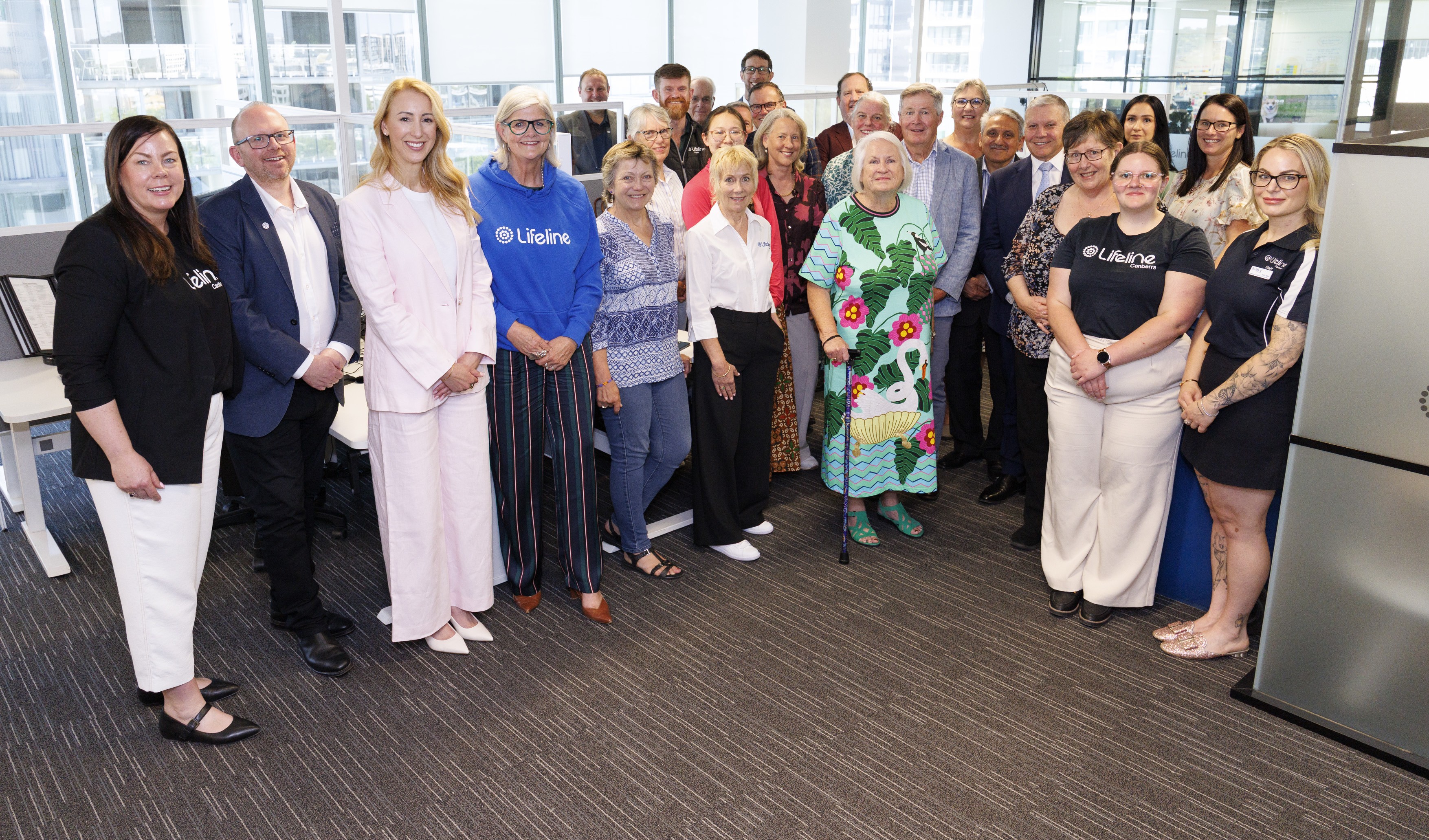
Carrie, thank you for inviting me to officiate today at the opening of this really marvellous centre. It says so much about your commitment to the volunteers and the team and those who call. I'm struck immediately, coming in, at the light. I've been to many places where this kind of work is done—back rooms, no windows—the thought being it's all about being on the phones.
This is all about the people on the phones being able to access nature or people and a sense of light. And light is such an important part of our wellbeing. So congratulations on committing to such a beautiful, empowering, and inspiring space. It's lovely to see it.
I can't help but notice that just across the hallway you have my predecessor, former Governor-General David Hurley, just a door away. I'm sure he will be a great supporter. Lifeline has always been a very important part of the role of the Governor-General.
Thank you for hosting me and Simeon, my husband, who can't be here today, in the Naarm offices. That was a beautiful moment. We were on our way to the Big Freeze supporting Neale Daniher on that day. We had a beautiful morning with you. We walked into the offices and felt very spoiled, and it was your care for us.
But this looks glorious. It feels—just glancing into your other parts of this office and the wall of pets—everything about this speaks of that deep care for the people who work here.
And the other thing I remember at Naarm was the video—Carol—and we were all deeply, deeply moved just watching and absorbing that call and both the impact on the volunteer, but also what's happening in that moment, just how things shifted and changed. It gave us such a deep understanding about the reality of being a volunteer and the life-saving work that goes on with Lifeline.
I want to acknowledge all of you—the staff, the board, the chair, everyone involved in Lifeline Canberra. You're 55 years old. I'm 60, so I was born in '65; you arrived in about 1970, it must be. So as the first Canberra-born Governor-General, I have a very, very strong association with this place—with Canberra.
Whilst I was born here, we were on the move for the next seven or eight years with my father's postings in the Army, but we were back in Canberra for the very end of my primary school and high school. And so Lifeline Canberra is seared into my memory.
The Lifeline Book Fair started in 1973, I think. So for me, every time I pass by the Albert Hall, I have visions of going there every year. My dad always scooped up all our books to take to the Lifeline Book Fair, and we always brought back more than we had given.
You could not miss the Lifeline Book Fair. You had to get there early to make sure you got the best haul. I remember friends of mine who had real troubles at university, friends of mine through my father's connections in the Defence Force, who were calling Lifeline in Canberra and receiving that incredible support. And it always struck me that the need to call Lifeline is not determined by anyone's economic background or social standing. It's everyone—and it's everyone in that moment of crisis.
So Lifeline in Canberra has been something that's been in my memory for as long as I can remember. So it feels very special to be here today, to open your facility here, to see it done so beautifully.
I was just going to reflect very briefly on a couple of your numbers, though, because I thought they were staggering—and you've already given us some—the millionth caller sometime next year, which just says so much about the need here in Canberra.
So in this year alone, you've answered almost 42,000 calls—10% more than the year before. So even though, as a country, I think we think we're doing better on some of our mental health supports, we know that there is an extraordinary rise in loneliness—one of the fastest rises in loneliness—possibly post-COVID, possibly it's about us not knowing how to really invest in community.
And we know that hits everywhere. But to see a 10% rise in your numbers would suggest that there are things in Canberra that still require very close attention.
21,000 hours of crisis support, standing alongside more than 5,000 people who actually expressed suicidal thoughts—and you're saving lives for them. Those numbers really stood out to me.
But you also trained 151 new local crisis supporters. So congratulations on all that work. Quite often those who work for Lifeline started as volunteers. All have come from very senior roles and now volunteer. So there's something extraordinary about the way in which everyone in Lifeline comes together.
So I just want to acknowledge all of you for the work that you do. I spent a lot of time working in mental health. I served as a Commissioner on the National Mental Health Commission. I chaired Beyond Blue before coming into this role. It's been a big part of things that I've done.
So I'm very conscious of: Where does good reside? And where does care reside?
For me, you embody everything I've promised to do as your Governor-General—care and kindness and respect. And I see those virtues and those commitments here.
You also do something that the Prime Minister has asked me to be, which is to be modern and visible and optimistic. And I think for me, those six words are helping me define when I spend my time and the focus I give to my role.
Against those numbers—the growth in the service needs, the fact that loneliness is growing—we've got to hold on to an optimistic view of our country and our people. That visibility about the issues matters—so sharing your statistics with people, doing that with kindness and care, but also being very modern.
And so this modernity that's in this office—that shows a lot about how a light-filled office, volunteers, the technology, the systems, the training—that's a very modern version of something that wouldn't have been the case 55 years ago.
So I think we're in a joint project—the Office of Governor-General and all of you—about how we will have our deep belief in our country, but also how we deal with this incredible problem of loneliness and people reaching out.
One of your volunteers said—and it goes to Greg's point—we're not here to solve people's problems. We're here primarily to hear their pain and sit with them.
But I was struck by this. This is a volunteer from here:
“Even though people's lives are so hard and complicated, I mostly feel privileged to be trusted with what they have to say. I'm also amazed they have the courage to reach out for help. Sometimes I wonder if I have the energy to keep doing it, but I can't seem to stop showing up.”
I suspect that would be the sentiment of most of the volunteers. It is exhausting, hard work. It's deeply emotional, but you keep showing up. You don't give up, which says so much about your care and the courage you have as the volunteers and the people who work here—as much as the courage of someone picking up the phone.
So I think what you do is invaluable. It's one of the deepest forms of care I can imagine. And I congratulate you on all the work you've done in the 55 years to get here. But now this next stage of being this beautiful, purpose-built facility where you can feel uplifted when you come in here because of the heaviness of the work that you do on the phones.
But as the film Carol shows—the immense pride you must have in the satisfaction of lives saved, standing alongside those that have the courage to call.
So just a big thank you from me and from the entire team at the Office of the Governor-General. And I'll remain a very steadfast patron for Lifeline Australia—for you here—and happy to be your friend and supporter whenever you need us to step in and bring focus and attention to what you do.
So thank you for having me. I'll be delighted in a moment to do some ribbon cutting. And as you know, we just never know who those next calls will be from, but the lives you save—that tells me a story about care.